
Hiddenite
Curated by Maggie Liu · Updated:
About Hiddeniteextended article
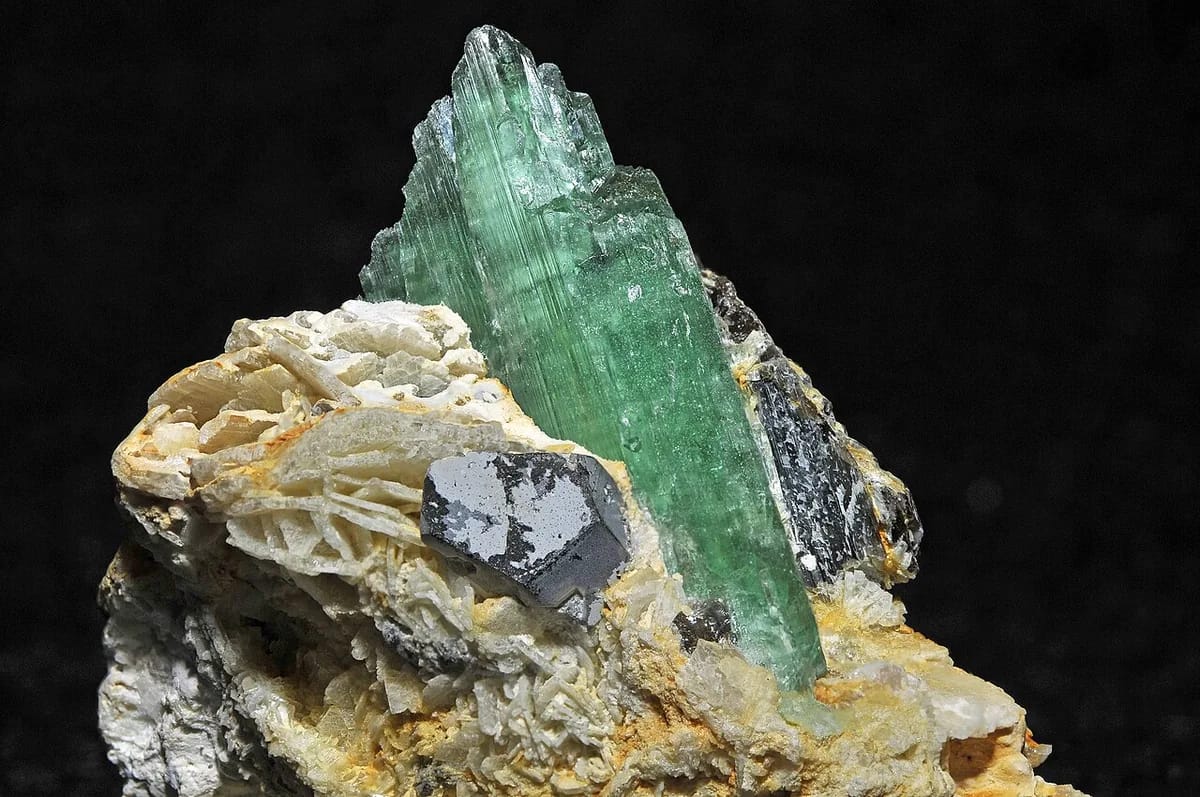
Hiddenite is the emerald-green, chromium-bearing gem variety of spodumene, a lithium aluminium pyroxene. It was first described in the 1880s from Alexander County, North Carolina, and named after the mineralogist William Earl Hidden. True hiddenite owes its green to chromium; paler yellow-green spodumene is more abundant but less valued.
Properties
Spodumene is monoclinic and forms flattened prismatic crystals with perfect prismatic cleavage, which — combined with a hardness of 6.5–7 — makes hiddenite a challenging stone to cut. It is transparent and strongly pleochroic, showing different green tints along different crystal directions. Its better-known sister variety is the pink-to-lilac kunzite.
Occurrence
Gem spodumene forms in lithium-rich granitic pegmatites. Besides the original North Carolina locality, fine spodumene comes from Afghanistan, Pakistan, Brazil and Madagascar, though chromium-coloured hiddenite specifically remains scarce.
Frequently asked questions
What is the chemical formula of Hiddenite?
The chemical formula of Hiddenite is LiAlSi2O6.
What crystal system does Hiddenite belong to?
Hiddenite crystallises in the Monoclinic crystal system.
Related minerals
Looking for a Hiddenite specimen?
Our inventory is one-of-a-kind and turns over quickly. Tell us what you're after — species, size, budget — and we'll notify you when a matching Hiddenite arrives from our sourcing network.
Request this mineral