
Olivine
Curated by Maggie Liu · Updated:
Olivine is the olive-green magnesium-iron silicate of the Earth's mantle and basalts; its gem variety is peridot.
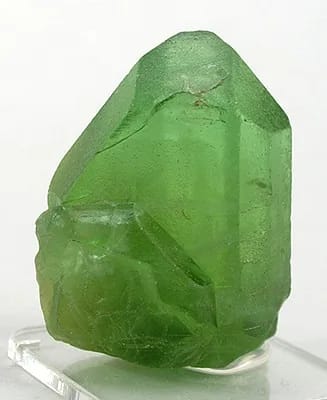
Olivine is a magnesium-iron silicate, the olive-green rock-forming mineral of the Earth's mantle; its gem variety is peridot.
About Olivineextended article
Olivine is a magnesium-iron silicate and one of the most abundant minerals in the Earth's mantle. Its olive-green colour gives the group its name, and it is a major component of basalt and of the mantle rock peridotite. Its transparent gem variety is known as peridot.
Identifying olivine
Olivine is fairly hard (6.5–7), glassy, and green to yellow-green, forming granular masses and stubby crystals. It occurs in dark, silica-poor (mafic and ultramafic) igneous rocks, and even in some stony-iron meteorites. On weathering it alters to brown and to serpentine.
Where it is found
Gem and specimen olivine comes from the basalt fields of Arizona, the island of Zabargad in the Red Sea, Pakistan's Sapat valley, Myanmar and China. Green olivine sand beaches form where basalt erodes, as in Hawaii.
For collectors
Sharp, gemmy green crystals and clean peridot are the most valued; olivine in meteorites and mantle xenoliths is of special scientific interest.
Frequently asked questions
What is Olivine?
Olivine has the chemical formula (Mg,Fe)2SiO4, crystallises in the Orthorhombic system, has a Mohs hardness of 6.5–7. Olivine is the olive-green magnesium-iron silicate of the Earth's mantle and basalts; its gem variety is peridot.
What is the chemical formula of Olivine?
The chemical formula of Olivine is (Mg,Fe)2SiO4.
What crystal system does Olivine belong to?
Olivine crystallises in the Orthorhombic crystal system.
Is Olivine rare?
As a collector mineral, Olivine is generally considered uncommon.
Related minerals
Looking for a Olivine specimen?
Our inventory is one-of-a-kind and turns over quickly. Tell us what you're after — species, size, budget — and we'll notify you when a matching Olivine arrives from our sourcing network.
Request this mineral