
Tanzanite

Crystal system · Orthorhombic

Tanzanite is the trichroic blue-violet variety of zoisite, a calcium aluminum silicate. It was first identified in 1967 at Merelani, Tanzania, the only commercial source.

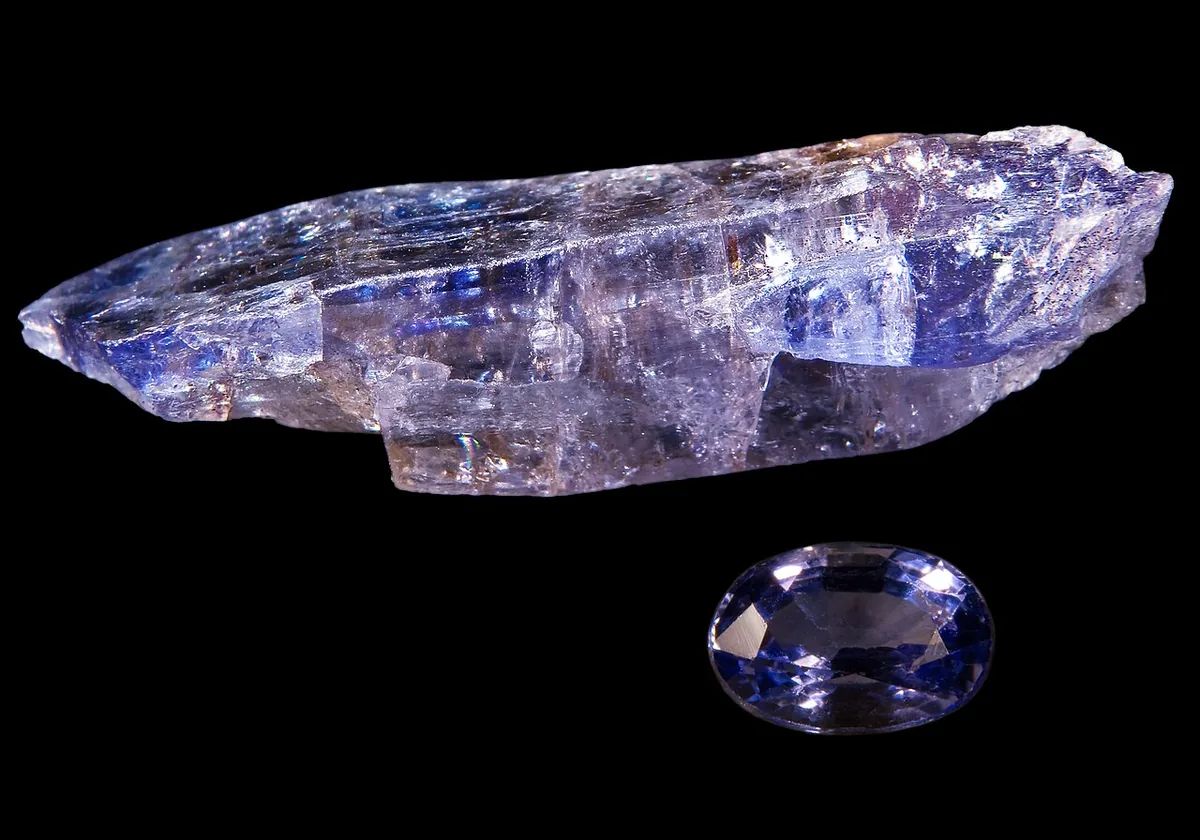
Tanzanite specimen
Photo: Didier Descouens · CC BY 3.0 via Wikimedia Commons

About Tanzaniteextended article

Formation eraPan-African metamorphic 580 Ma; only locality globally (Merelani Hills).
Market availability: Rare
Sought after; limited supply. Major shows and specialist dealers only.
Often found withGraphite · Tremolite · Quartz
Geological setting
PegmatiteMetamorphic
GroupEpidote Group
Related members: Epidote · Clinozoisite · Zoisite
Crystal system
Orthorhombic

Tanzanite is the trade name for the violet-blue gem variety of zoisite, found at exactly one locality on Earth: the Merelani Hills near Arusha, Tanzania. Discovered in 1967 and marketed worldwide by Tiffany & Co., tanzanite is one of the great gem stories of the late 20th century.

Occurrence

Unique locality: Merelani Hills, Manyara Region, Tanzania. Tanzanite forms in graphite-rich pegmatite-hosted gem pockets within metamorphic gneisses of the Mozambique Belt. Most rough is heat-treated (~600°C) to enhance the violet-blue color from natural brown-yellow tones.

Identification

Strong trichroism (blue, violet, brownish-yellow along crystal axes) + Tanzanian pedigree + perfect cleavage. Distinguish from sapphire (harder, no cleavage, isotropic blue) and iolite (lower density, weaker color).

Collector Notes

The Tanzanian government has restricted rough exports since the early 2000s; supply tightening has driven tanzanite into top-tier gem rarity territory. Crystallized rough specimens (uncut crystals on matrix) are increasingly valuable.

Export:BibTeXRIS
Quality criteria — what to look for
A-grade: Untreated material is exceptional. Sharp violet-blue trichroism. Most are heat-treated to remove brown (industry standard).
Common quality: Heat-treated tanzanite is the norm — disclosure standard since 1980s.
Avoid: Composite/diffusion-treated faux tanzanite, dyed quartz substitutes.
External research links for Tanzanite
Gemological optical data
Refractive index
1.691–1.700
Birefringence
0.009
Dispersion
0.030
Published: May 6, 2026 · Last reviewed: May 6, 2026
Editorial standards & sources →

About Tanzanite

Tanzanite is zoisite (Ca2Al3(SiO4)3(OH)) colored by vanadium and chromium. Its defining characteristic is trichroism — three distinct colors visible along the three crystal axes: blue, violet, and burgundy/brown. Most rough is heated to about 600 degrees Celsius to drive off the brown component, leaving the blue-violet hue that defines gem tanzanite. The species was discovered in 1967 and named by Tiffany & Co. after the country of origin.

Identification & care

Tanzanite has Mohs hardness 6.5 to 7 and specific gravity 3.35. It crystallizes in the orthorhombic system, with prismatic crystals showing well-developed striations parallel to the c-axis. Cleavage is perfect in one direction, which makes the gem cuttable but somewhat fragile. Luster is vitreous, the streak is white, and the trichroism is diagnostic — rotating the crystal shows blue, violet, and burgundy depending on viewing angle.

Collector context

Collector notes

Tanzanite is geographically restricted to a single locality (Block D in the Merelani hills), making it inherently rarer than diamond on a tonnage basis. Mineral specimens with terminated crystals on graphite-rich matrix are highly collectible, with material from the original D-Block command premium pricing. Unheated rough showing the natural tri-color is rarer than heated stones and worth a meaningful premium when properly documented.

Frequently asked questions

What is Tanzanite?

Tanzanite is the trichroic blue-violet variety of zoisite, a calcium aluminum silicate. It was first identified in 1967 at Merelani, Tanzania, the only commercial source.

What is the chemical formula of Tanzanite?

The chemical formula of Tanzanite is Ca2Al3(SiO4)(Si2O7)O(OH).

What crystal system does Tanzanite belong to?

Tanzanite crystallises in the Orthorhombic crystal system.

Where is Tanzanite found?

Notable localities for Tanzanite include Merelani Hills.

Is Tanzanite rare?

As a collector mineral, Tanzanite is generally considered rare.

References & databases

Mindat.org is the world’s largest open mineralogy database. Our descriptions are written independently and fact-checked.