
Tincalconite
Curated by Maggie Liu · Updated:
Tincalconite is a borate mineral recognized among collectors for its crystal form and distribution, with known Chinese sources.
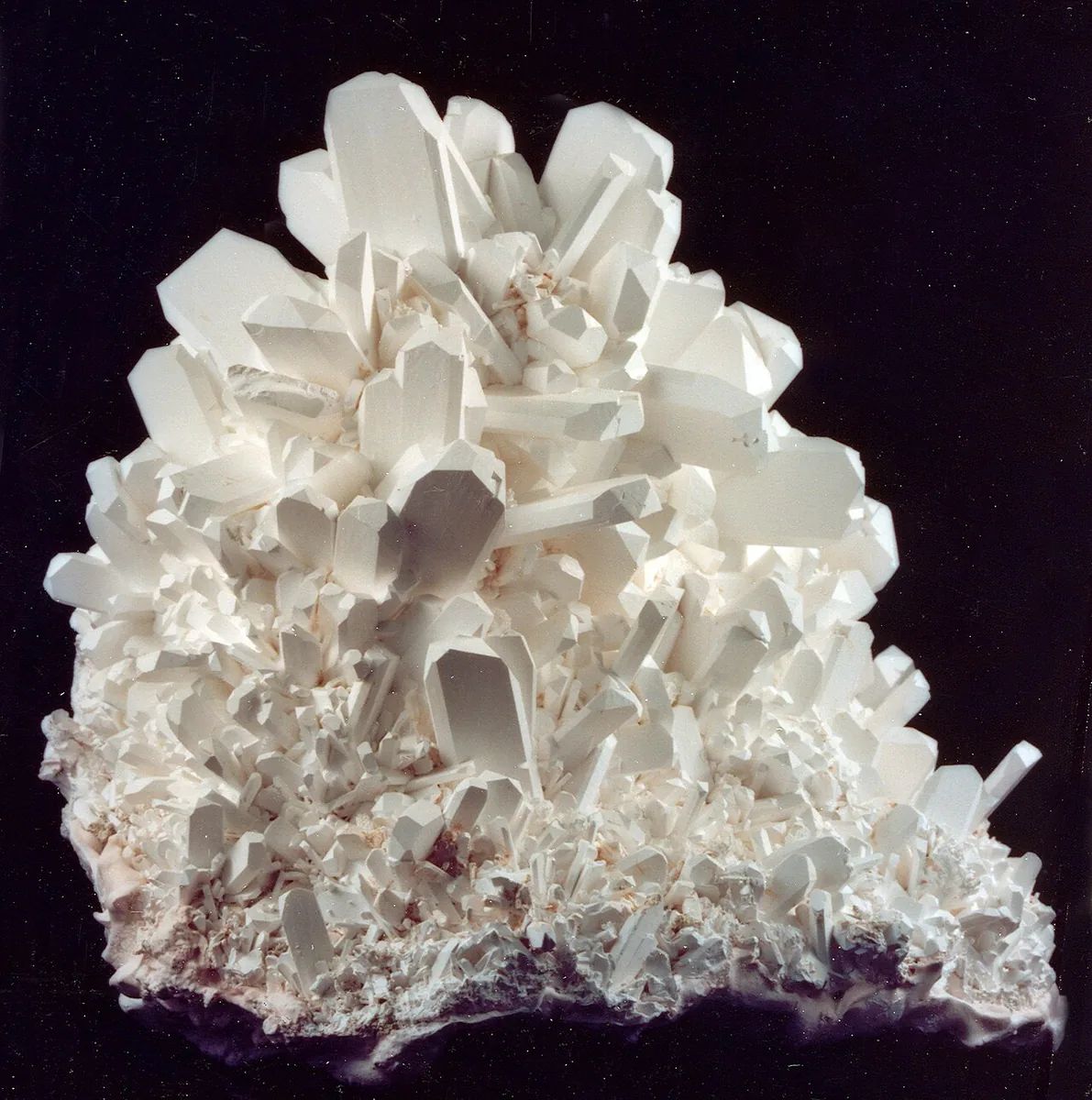
About Tincalconiteextended article
Tincalconite is a hydrated sodium borate and one of the family of evaporite borate minerals. It most often appears not as a primary growth but as a fine white powdery coating, formed when the better-known borate borax loses some of its water on exposure to dry air and recrystallises to this more stable, less hydrated phase.
Properties
It is trigonal but is usually seen as a chalky white to colourless crust or as tiny grains; it is soft and dissolves readily in water. Because it forms by dehydration of borax, specimens are often labelled as alteration products.
Occurrence
Tincalconite occurs in dry borate evaporite deposits and playa lake beds, classically in the Mojave Desert of California (Boron, Searles Lake) alongside borax, kernite and ulexite. It typically forms wherever borax specimens are stored in dry conditions.
About Tincalconite
Tincalconite is a borate mineral in the tincalconite group and has the chemical formula Na2B4O5(OH)4·3H2O. It crystallizes in the trigonal system and is relatively soft, requiring careful handling.
Identification & care
Specimens usually show powdery crusts; pseudomorphs after borax. Its color is typically white to colorless. The luster is vitreous to waxy, the streak is white, and specimens range from translucent to transparent. The cleavage is perfect on {0001}. The fracture is earthy, which aids identification.
Collector context
Collector notes
For collectors, Tincalconite is a benchmark crystalline species. Tincalconite has known Chinese occurrences in Tibet, Qinghai.
Frequently asked questions
What is Tincalconite?
Tincalconite crystallises in the Trigonal system. Tincalconite is a borate mineral recognized among collectors for its crystal form and distribution, with known Chinese sources.
What crystal system does Tincalconite belong to?
Tincalconite crystallises in the Trigonal crystal system.
Related minerals
Looking for a Tincalconite specimen?
Our inventory is one-of-a-kind and turns over quickly. Tell us what you're after — species, size, budget — and we'll notify you when a matching Tincalconite arrives from our sourcing network.
Request this mineral