
Why symmetry matters
A crystal's external faces, growth angles, and cleavage directions are all consequences of how its atoms repeat in space. Two minerals with completely different chemistries can produce crystals that look almost identical because they share a crystal system. Once you can name the system at a glance, identification narrows from 5,000+ minerals to a handful.
The seven systems
Cubic (highest symmetry — fluorite, pyrite, galena, garnet). Hexagonal (six-fold axis — beryl, apatite). Trigonal (three-fold axis — quartz, calcite, tourmaline). Tetragonal (four-fold axis — cassiterite, rutile, scheelite). Orthorhombic (three perpendicular axes of unequal length — barite, topaz, sulfur). Monoclinic (one oblique angle — gypsum, azurite, orthoclase). Triclinic (lowest symmetry, three unequal oblique axes — plagioclase, kyanite, rhodonite).
How to use it in the field
Look first at the crystal habit — is it a cube? A hexagonal prism? A rhomb? Count the faces meeting at a corner. Check whether opposite faces are parallel. Within thirty seconds you should be able to rule out 4–5 systems and have your candidate list down to one or two. Combine with hardness and streak and you've solved most IDs.
The axes behind each system
Every crystal system is defined by a set of imaginary reference lines — crystallographic axes — and the angles between them. The cubic system has three equal axes meeting at right angles, which is why its crystals look the same from many directions. As you move down the list, the axes become progressively less equal and the angles less square: orthorhombic keeps the right angles but unequal lengths, monoclinic tilts one axis, and triclinic abandons right angles entirely.
You don't need to measure anything to use this. The takeaway is intuitive: high-symmetry minerals (cubic, hexagonal) tend toward blocky, equant, or evenly prismatic shapes, while low-symmetry minerals (monoclinic, triclinic) lean toward wedge-shaped, lopsided, or bladed crystals. When a crystal looks 'skewed' rather than 'regular,' you are usually looking at the bottom of the symmetry ladder.
Trigonal vs. hexagonal: the common confusion
New collectors routinely mix up the trigonal and hexagonal systems because both can show six-sided prisms. The difference is the principal axis of symmetry: hexagonal has a six-fold axis, trigonal only a three-fold. Quartz is the textbook trap — it grows handsome six-sided prisms yet is trigonal, not hexagonal, a fact you can sometimes confirm from the alternating large and small rhombohedral faces capping the tip.
A practical tell is to look at the terminations and face development rather than just counting prism faces. Apatite (true hexagonal) tends toward clean, symmetric six-fold caps; quartz often shows that uneven, two-rhombohedron termination. If you only count the prism, you will guess wrong about half the time — always check the symmetry of the point.
Reading systems on Chinese specimens
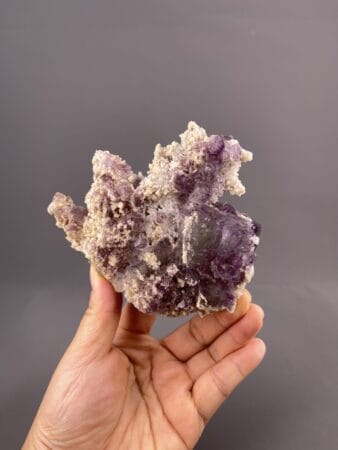
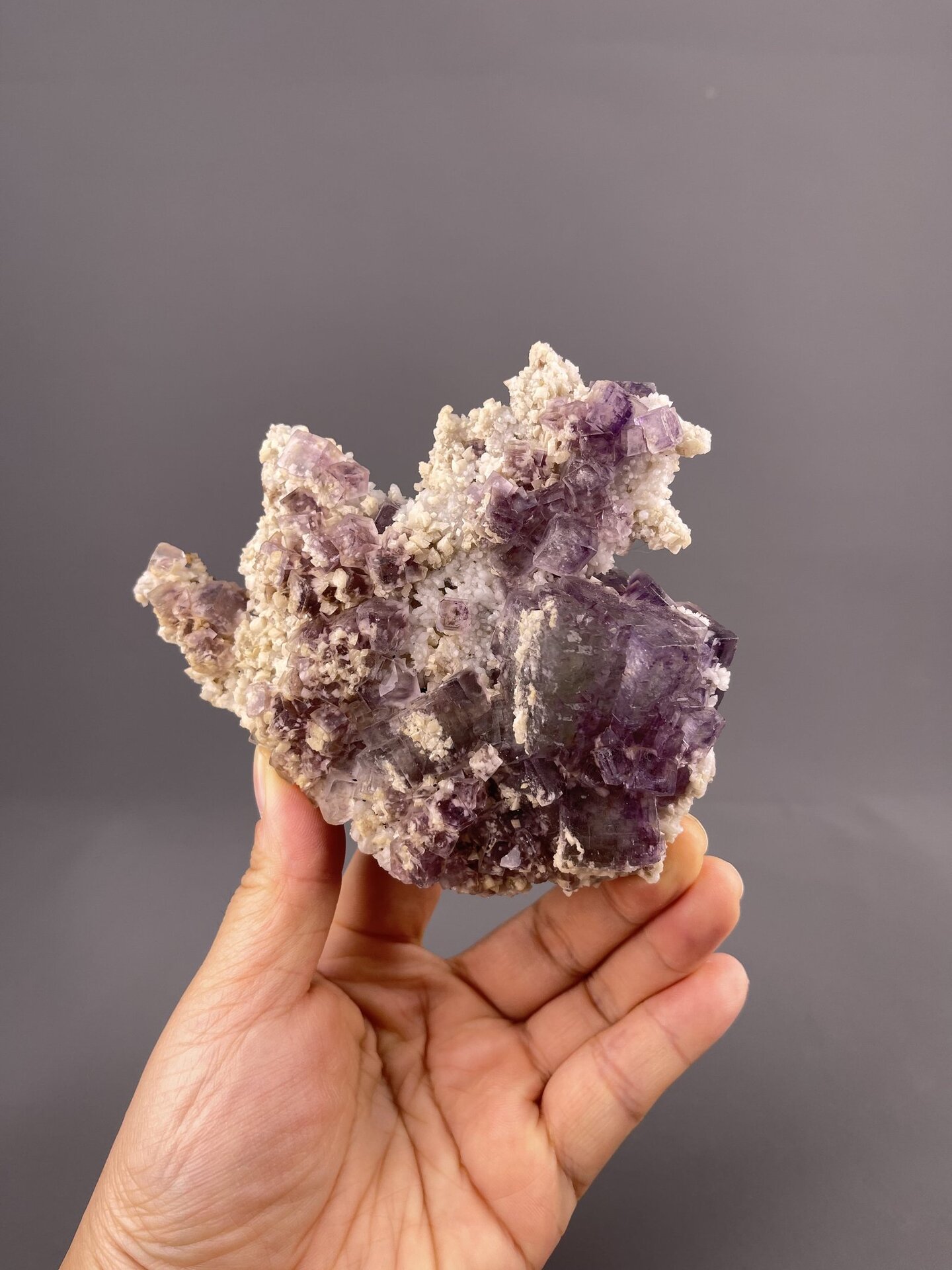
Chinese localities are an unusually good classroom for crystal systems because so many produce textbook-clean crystals. Cubic fluorite from Yaogangxian in Hunan grows as crisp cubes and octahedra that make the cubic system obvious at a glance, while Sichuan's Xuebaoding scheelite shows the bipyramidal habit typical of the tetragonal system.
Stibnite from the Lengshuijiang–Xikuangshan district in Hunan is a fine orthorhombic study: its steely, deeply striated blades and needles reflect the unequal axes of that system. Collecting across just these few sources — cubic fluorite, tetragonal scheelite, orthorhombic stibnite, plus trigonal quartz that turns up almost everywhere — lets you build a hands-on reference set covering most of the seven systems without ever leaving Chinese material.
Frequently asked questions
How many crystal systems are there — six or seven?
Modern mineralogy most often teaches seven crystal systems, separating trigonal from hexagonal. Some older texts and crystallographic conventions group trigonal under hexagonal, giving six. Both schemes describe the same minerals; the seven-system version is the more common reference for collectors.
Can I tell a mineral's crystal system just by looking?
Often yes for well-formed crystals, but not always. A clean cube, hexagonal prism, or rhomb points strongly to a system, yet poorly formed, massive, or twinned specimens can hide it. Treat the system as your first clue and confirm with hardness, cleavage, and streak.
Why is quartz trigonal when it looks six-sided?
Quartz forms six prism faces but has only three-fold symmetry around its main axis, which places it in the trigonal system. The giveaway is the termination: the capping rhombohedral faces are usually uneven rather than a symmetric six-fold point.
Does the crystal system affect how a specimen breaks?
Yes. Cleavage directions and angles are dictated by the atomic lattice, so they track the symmetry of the system. Cubic galena cleaves into right-angle cubes, while trigonal calcite cleaves into rhombs — the breakage echoes the structure.