
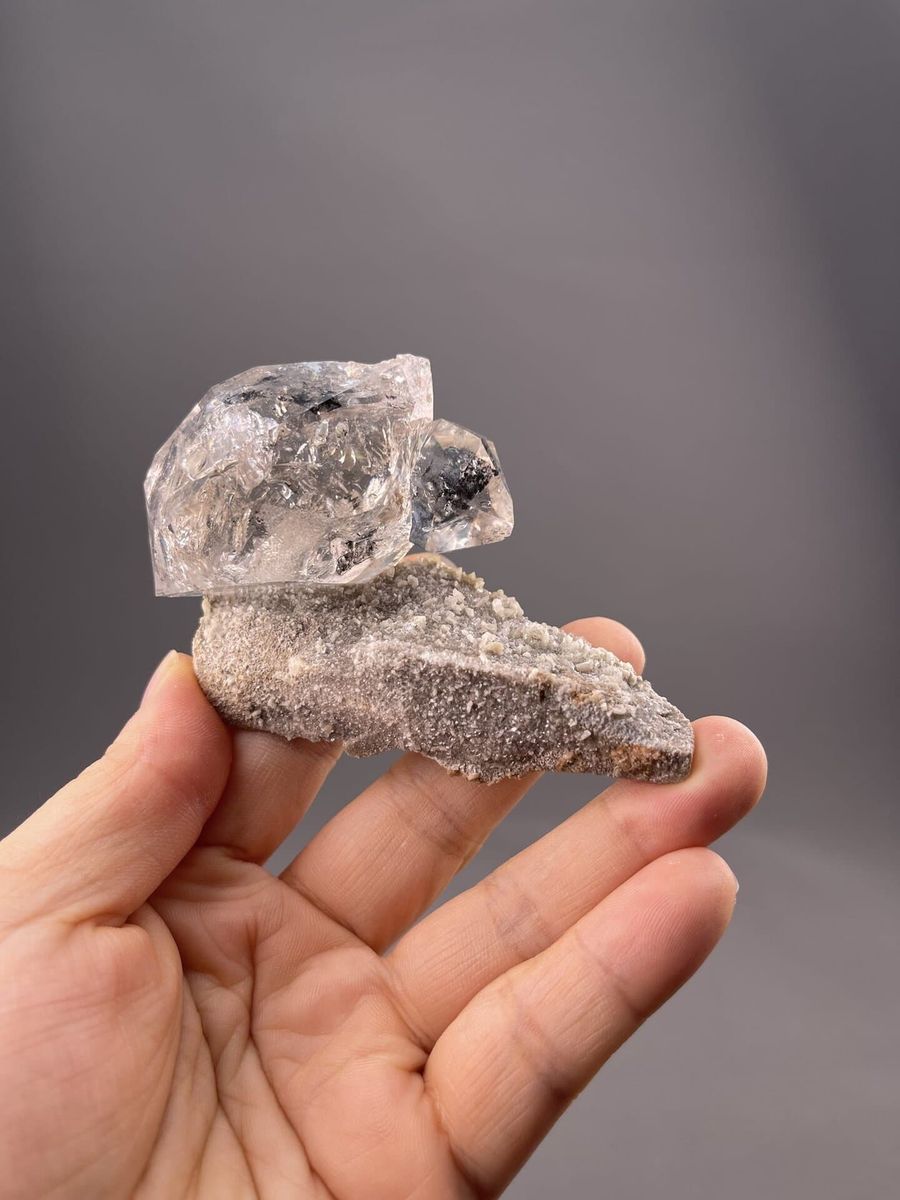
Single-crystal habits
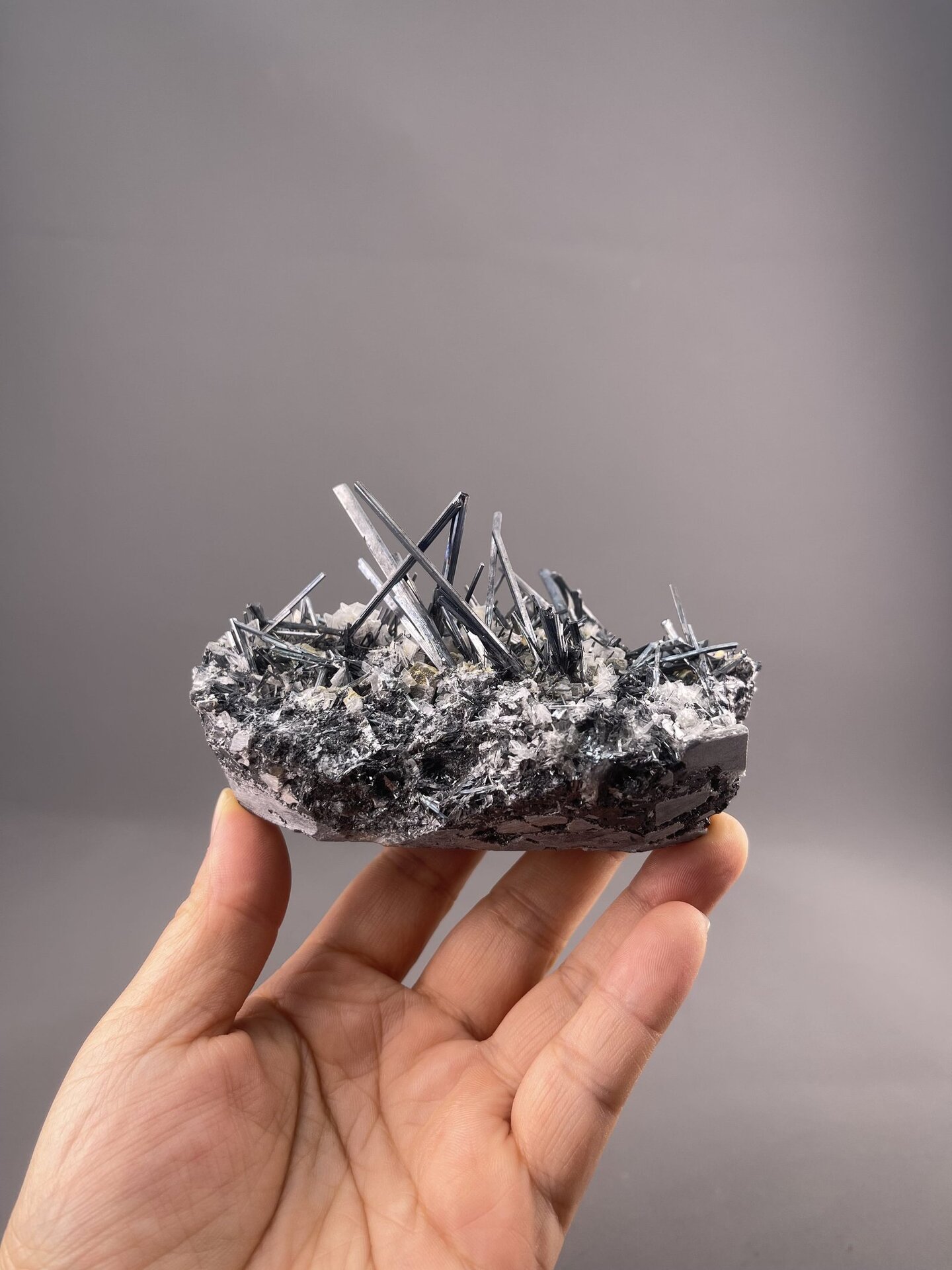
Prismatic — long parallel faces, often capped by terminations. Tabular — flat, plate-like (barite, hanksite). Acicular — needle-like, slender (stibnite, natrolite). Bladed — broad and flat with sharp edges (kyanite). Equant — roughly cube- or sphere-like (garnet, pyrite). Pyramidal — tapering to a point (rutile, scheelite).
Aggregate habits
Botryoidal — clustered rounded masses (hemimorphite, smithsonite, malachite). Reniform — kidney-shaped (hematite). Mammillary — large smooth domes. Druzy — a coating of tiny crystals on a matrix. Dendritic — tree-like branching (native silver, pyrolusite manganese on limestone). Massive — no visible crystals, just solid mineral (lapis lazuli, jade). Granular — many small grains (peridot in olivine matrix).
Why habit predicts identity
Crystal habit is dictated by the same atomic arrangement that defines the crystal system, plus the growth-environment temperature and rate. A mineral grown slowly in an open vug will show large euhedral crystals; the same species formed quickly in a hot vein will be massive or fibrous. Knowing both the typical habit AND the typical exceptions for each major species is the difference between hobbyist guessing and professional ID.
Euhedral, subhedral, and anhedral
Before you name a habit, judge how well-formed the crystal is. Euhedral crystals have complete, sharp faces because they grew freely into open space; subhedral crystals are partly formed; anhedral grains show no crystal faces at all because neighboring crystals crowded them out as they grew. Collectors prize euhedral specimens, and most of the classic habits — prismatic, tabular, bladed — are only obvious when crystals are euhedral.
This is also why two specimens of the same mineral can look nothing alike. Fluorite that crystallizes into an open pocket forms textbook cubes, while fluorite that fills the last gaps between earlier minerals may be anhedral and shapeless. When a habit is hard to read, ask first whether the crystal even had room to develop faces.
How growth conditions shape habit
Habit is not fixed by chemistry alone — temperature, the chemistry of the fluid, available space, and growth speed all push a mineral toward one shape or another. Rapid growth from a supersaturated solution tends to favor slender, needle-like (acicular) or skeletal forms, while slow, steady growth favors chunky, well-faced crystals. Trace impurities can even poison certain faces and force a crystal to elongate or flatten in a particular direction.
A practical consequence is that the same species shows different signature habits at different localities. Calcite is the extreme case, appearing as sharp dogtooth scalenohedrons in one deposit and blunt nailhead rhombs in another. When you learn a habit, learn it as 'this mineral, from this kind of setting,' not as an unbreakable rule.
Signature habits of Chinese minerals
Several Chinese localities are famous precisely because their crystals show a habit so cleanly. Stibnite from the Lengshuijiang–Xikuangshan area of Hunan grows as long, gleaming acicular-to-bladed swords; published collector literature records how Chinese examples changed the standard previously set by Japanese classics. Pyrite from the Daye district near Huangshi in Hubei tends toward bright, equant cubes on carbonate matrix.
Fluorite from Yaogangxian in Hunan typically shows crisp cubic and octahedral habits, sometimes with stepped or phantom growth, and quartz across many Chinese deposits takes the expected prismatic form capped by rhombohedral terminations. Studying these alongside botryoidal aggregates such as malachite gives a collector a compact, hands-on tour of both single-crystal and aggregate habits using widely available material.
Frequently asked questions
What is the difference between crystal habit and crystal system?
The crystal system is the underlying symmetry of a mineral's atomic lattice, while the habit is the external shape an individual specimen actually grew into. One system can produce many habits depending on growth conditions, which is why habit alone is a clue rather than proof.
Why do two specimens of the same mineral look completely different?
Growth conditions differ. Available space, temperature, fluid chemistry, and growth speed all steer habit, so the same species can be sharp euhedral crystals in one pocket and massive or fibrous in another. Calcite is the classic example, with hundreds of documented habits.
Can I identify a mineral from habit alone?
Sometimes, for very distinctive habits like stibnite needles or botryoidal malachite. More often habit narrows the candidates, and you confirm with hardness, cleavage, streak, and crystal system. Treat a striking habit as a strong hint, not a final answer.
What does 'druzy' mean on a specimen description?
Druzy describes a surface carpeted with many tiny, closely packed crystals, often sparkling. It is an aggregate habit rather than a single crystal form, common on quartz and on oxidized matrices, and is valued for its glittering display effect.