
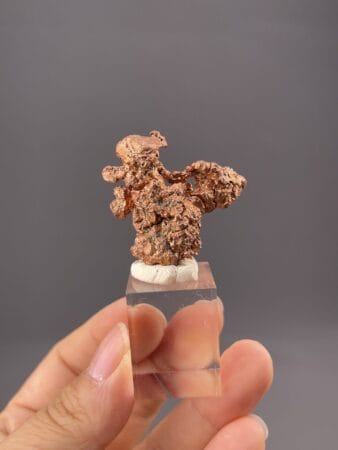
Idiochromatic vs. allochromatic
Idiochromatic minerals get their color from an essential element in their formula — malachite is always green because copper is required. Azurite is always blue for the same reason. These colors are diagnostic. Allochromatic minerals get their color from trace impurities — fluorite is naturally colorless but trace europium turns it purple, iron turns it green, and yttrium-cerium combinations produce the famous blue-green color zoning. Allochromatic color is decorative, not diagnostic.
Pleochroism
A pleochroic mineral shows different colors when viewed along different crystallographic axes. Cordierite shifts from violet through blue-grey to yellow as you rotate it. Tourmaline often goes from intense color along the c-axis to pale or colorless perpendicular to it. Pleochroism is a strong identification clue and a beauty in itself — many collectors specifically chase pleochroic specimens.
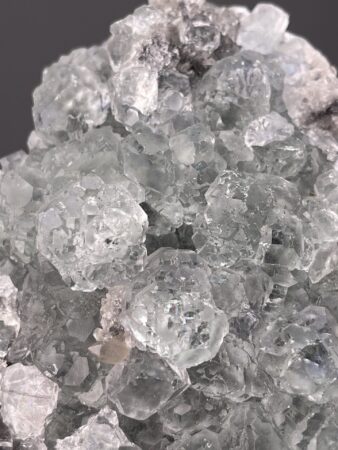
Fluorescence
Ultraviolet light excites electrons in certain minerals, which then emit visible light as they relax — fluorescence. Calcite from Franklin glows red-orange under short-wave UV. Scheelite blazes blue-white. Fluorite is variable but often green or violet. A short-wave + long-wave UV lamp turns a dark cabinet into a kaleidoscope. Some specimens that look mediocre in daylight are headline pieces under UV.
What actually causes color
Most mineral color comes from how the structure interacts with light at the atomic scale. The biggest source is transition-metal elements such as iron, copper, chromium, and manganese, whose electrons absorb specific wavelengths and leave the rest to reach your eye — copper greens and blues, chromium reds and emerald greens. A second source is color centers: tiny lattice defects, often created by natural radiation, that trap electrons and absorb light, which is what gives much purple fluorite and smoky quartz its hue.
The practical lesson for a collector is that the very same impurity can color completely unrelated minerals, and the same mineral can take many colors from different impurities. That is why color is a starting hint, not an identification — a green crystal might owe its color to copper, chromium, iron, or a color center, and only the rest of the toolkit tells you which.
Using a UV lamp safely and well
Fluorescence is split between long-wave (around 365 nm) and short-wave (around 254 nm) ultraviolet, and many minerals respond to only one. Scheelite is the classic short-wave performer, glowing bright blue-white, which makes a UV lamp a genuine field tool for telling scheelite from look-alikes. A dual short-wave/long-wave lamp is therefore far more useful than a cheap long-wave-only light, and you should always view in a fully darkened room for the effect to register.
Safety matters: short-wave UV can harm unprotected eyes and skin, so wear UV-blocking goggles, avoid shining it at people, and limit exposure. Also distinguish fluorescence (glow only while the lamp is on) from phosphorescence (an afterglow that lingers in the dark) and from simple body color — a specimen that merely looks bright under white light is not fluorescing at all.
Color and fluorescence in Chinese specimens
Chinese material offers excellent, accessible examples of every effect in this article. Fluorite from Yaogangxian in Hunan is a showcase of allochromatic color and color zoning, ranging through purple, green, and blue in a single piece, and much of it fluoresces under long-wave UV — a perfect demonstration that color and fluorescence are separate phenomena. By contrast, malachite is idiochromatic green wherever it forms, because copper is built into its formula.
Scheelite from Xuebaoding in Sichuan is one of the best illustrations of short-wave fluorescence available to collectors, lighting up blue-white in a way that confirms the species instantly. Building a small comparison set — allochromatic fluorite, idiochromatic malachite, and fluorescent scheelite — turns abstract optics into something you can switch on and see for yourself.
Frequently asked questions
Why is color considered unreliable for identifying minerals?
Because most mineral color comes from trace impurities or lattice defects rather than the mineral's essential chemistry. Fluorite alone appears purple, green, blue, yellow, or colorless, and unrelated minerals can share a color, so it only narrows the field rather than confirming an identity.
What is the difference between fluorescence and phosphorescence?
Fluorescence is the glow a mineral emits only while ultraviolet light is shining on it, stopping instantly when the lamp is off. Phosphorescence is an afterglow that continues for seconds or longer in the dark after the lamp is removed.
Do I need short-wave or long-wave UV for minerals?
Both are useful because many minerals respond to only one. Long-wave (about 365 nm) is safer and cheaper, but classics like scheelite glow best under short-wave (about 254 nm). A dual-wavelength lamp covers the widest range of specimens.
What is pleochroism and how do I see it?
Pleochroism is a mineral showing different colors when viewed along different crystallographic directions. You see it by rotating a transparent crystal in transmitted light; tourmaline and cordierite are strong examples, shifting between intense and pale or contrasting colors as they turn.