
Jamesonite

Crystal system · Monoclinic

Jamesonite is a sulfosalt mineral known for its striking metallic crystals, with known Chinese sources.

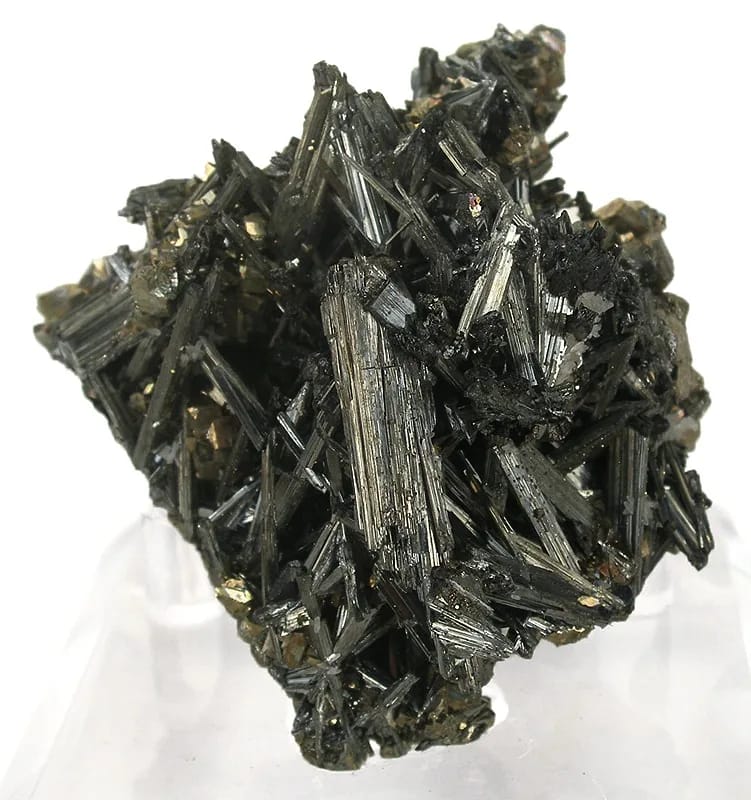
Jamesonite specimen
Photo: Robert M. Lavinsky · CC BY-SA 3.0 via Wikimedia Commons

About Jamesoniteextended article

China-iconic

China is a defining locality for Jamesonite · 脆硫锑铅矿. See the Chinese collector page →

Market availability: Uncommon
Found at major shows and select dealers. Quality varies by locality.
Collector tier: Cabinet Classic
World-class display species — sought after for cabinet collections, well-documented localities, frequent show-piece pieces.
Often found withBournonite · Stibnite · Pyrite · Quartz
Nickel–Strunz 2.HB.15a
Dana 03.06.06.01
Crystal system
Monoclinic

Jamesonite is a lead-iron-antimony sulfosalt that crystallizes as fine, hair-thin acicular needles, sometimes forming felted matted masses (“feather ore”). It is one of the few common sulfides that exhibits genuine fibrous habit.

Occurrence in China

Jamesonite is the signature collector species of the Yaogangxian mine, Hunan alongside bournonite, where lustrous black needle bundles up to 10 cm long are produced. Wuzhou (Guangxi) and various Yunnan Pb-Zn-Sb mines produce additional material. Cornwall (UK) and Bolivia also yield notable specimens.

Identification

Hair-fine acicular metallic needles + hexagonal cross-section + Pb-Sb mining association. Distinguish from boulangerite (similar habit but typically thicker and more lustrous) by chemistry — only chemical analysis is fully decisive.

Collector Notes

Yaogangxian “feather ore” jamesonite needles standing on quartz drusy or arsenopyrite are among the most dramatic Chinese sulfide specimens. Care: fragile.

Export:BibTeXRIS
External research links for Jamesonite
Published: May 6, 2026 · Last reviewed: May 6, 2026
Editorial standards & sources →

About Jamesonite

Jamesonite is classified as a sulfosalt mineral in the jamesonite group and has the chemical formula Pb4FeSb6S14. It crystallizes in the monoclinic system and is relatively soft, requiring careful handling.

Identification & care

Jamesonite typically forms acicular, fibrous, plumose ('feather ore'); massive. Its color is typically steel gray to lead gray. The luster is metallic, the streak is gray-black, and specimens are typically opaque. The cleavage is perfect {001}. The fracture is uneven, which aids identification.

Collector context

Collector notes

In the metallic-crystal category, Jamesonite is a consistent target for serious collectors. Jamesonite is widely represented across Chinese provinces, including Gansu, Anhui, Guizhou, Guangdong.

Frequently asked questions

What is Jamesonite?

Jamesonite is a sulfosalt mineral known for its striking metallic crystals, with known Chinese sources.

What crystal system does Jamesonite belong to?

Jamesonite crystallises in the Monoclinic crystal system.

Is Jamesonite rare?

As a collector mineral, Jamesonite is generally considered uncommon.

References & databases

Mindat.org is the world’s largest open mineralogy database. Our descriptions are written independently and fact-checked.