
Morganite
Curated by Maggie Liu · Updated:
Morganite is a cyclosilicate mineral valued for its hardness and gem potential.
About Morganiteextended article
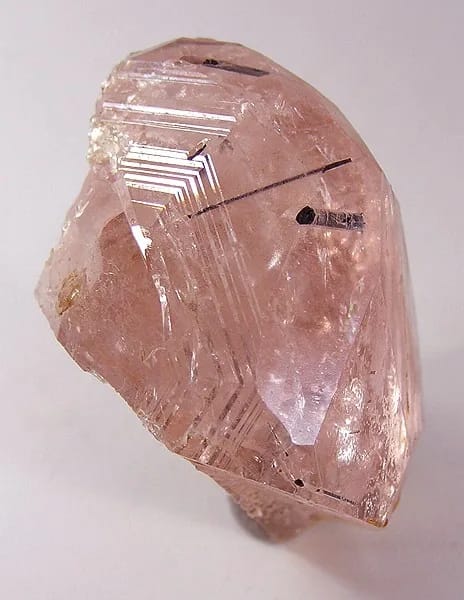
Morganite is the pink-to-peach gem variety of beryl, coloured by traces of manganese. It was named in 1911 after the financier and gem collector J. P. Morgan. Its soft, romantic pink has made it a popular modern jewellery stone, often shown in large, clean crystals.
Properties
Like all beryl it is hexagonal, hard (7.5–8) and forms prismatic to tabular crystals. Morganite is usually remarkably clean, and some material is gently heated to remove yellowish tints and emphasise the pink.
Occurrence
It forms in granitic pegmatites alongside other gem beryls. Brazil, Madagascar, Afghanistan, Pakistan and California (the Pala district) are notable sources. Related beryls include aquamarine, heliodor and colourless goshenite.
About Morganite
Morganite is classified as a cyclosilicate mineral in the beryl group and has the chemical formula Be3Al2Si6O18. It crystallizes in the hexagonal system and is one of the most visually varied minerals in the collector market.
Identification & care
Crystals commonly develop as prismatic hexagonal, often tabular; crystals may be large. Its color range is broad, including pink, rose, peach, salmon, and violet-pink. The luster is vitreous, the streak is white, and specimens range from transparent to translucent. The cleavage is imperfect basal. The fracture is conchoidal, which aids identification.
Collector context
Collector notes
For gem and crystal collectors, Morganite is a top-tier reference species.
Frequently asked questions
What is Morganite?
Morganite has the chemical formula Be3Al2Si6O18, crystallises in the Hexagonal system, has a Mohs hardness of 7.5–8. Morganite is a cyclosilicate mineral valued for its hardness and gem potential.
What is the chemical formula of Morganite?
The chemical formula of Morganite is Be3Al2Si6O18.
What crystal system does Morganite belong to?
Morganite crystallises in the Hexagonal crystal system.
Where is Morganite found?
Notable localities for Morganite include Pala District.
Is Morganite rare?
As a collector mineral, Morganite is generally considered uncommon.
Related minerals
Looking for a Morganite specimen?
Our inventory is one-of-a-kind and turns over quickly. Tell us what you're after — species, size, budget — and we'll notify you when a matching Morganite arrives from our sourcing network.
Request this mineral