Computed from simplified end-member formula. Solid-solution series, water content, and trace substitutions cause real-world variation.
IMA Abbreviation (Whitney-Evans 2010)
Brl
→ Beryl
Pegmatite assemblages
Standard symbol from American Mineralogist (Whitney & Evans, 2010). Used in thin-section labeling, phase diagrams, and IMA-style species records.
Pronunciation
/ˈbɛrəl/
↔ BEH-ril
two syllables (Greek)
Lapidary & Faceting Recommendations
Recommended cut:
step / oval
Also seen:
cushion, emerald
Typical yield:
35% of rough
General beryl group — see species (emerald/aquamarine etc.).
UV Fluorescence
SW (254 nm)
—
none
LW (365 nm)
—
none
Pure beryl inert; Cr/V-bearing emerald may show weak red.
SW = shortwave (germicidal lamp). LW = longwave (blacklight). Response varies with locality, trace impurities, and treatment.
Tenacity
Behavior:
brittle
Under stress:
Conchoidal fracture
Hard but brittle — emerald especially fragile due to "jardin".
Luster
vitreous
Standard glass-like.
Diaphaneity (Transparency)
transparent-to-translucent
Gem-quality transparent.
Type Locality
(ancient term — Greek "beryllos")— Worldwide
Source: Pliny
› Browse all type localities
Magnetism
Category:
diamagnetic
Test result:
Slight repulsion
Be₃Al₂(SiO₃)₆; pure form diamagnetic.
Test with rare-earth magnet (N42 or N52 neodymium). Suspend specimen on thread for sensitive paramagnetic detection. Diamagnetic minerals are weakly repelled (visible only with strong magnets like bismuth).
Specific Gravity
2.66–2.92
g/cm³
light
Higher SG in Fe-rich (heliodor) and Cs-rich pegmatitic material.
For comparison: water = 1.00, glass ≈ 2.5, quartz = 2.65, corundum ≈ 4.00, galena ≈ 7.50, gold ≈ 19.3.
Beryl sits at 7.5–8 on the Mohs scale —
very hard; only diamond or corundum scratches it.
Colors:
Streak White
Crystal system Hexagonal
Pronunciation/ˈbɛrɪl/
Type localityLimoges region, France (classical)
Discovery First described 1798 by Louis-Nicolas Vauquelin (France)
SilicatesSilicates (Cyclosilicates)
TL;DR · 1 min read
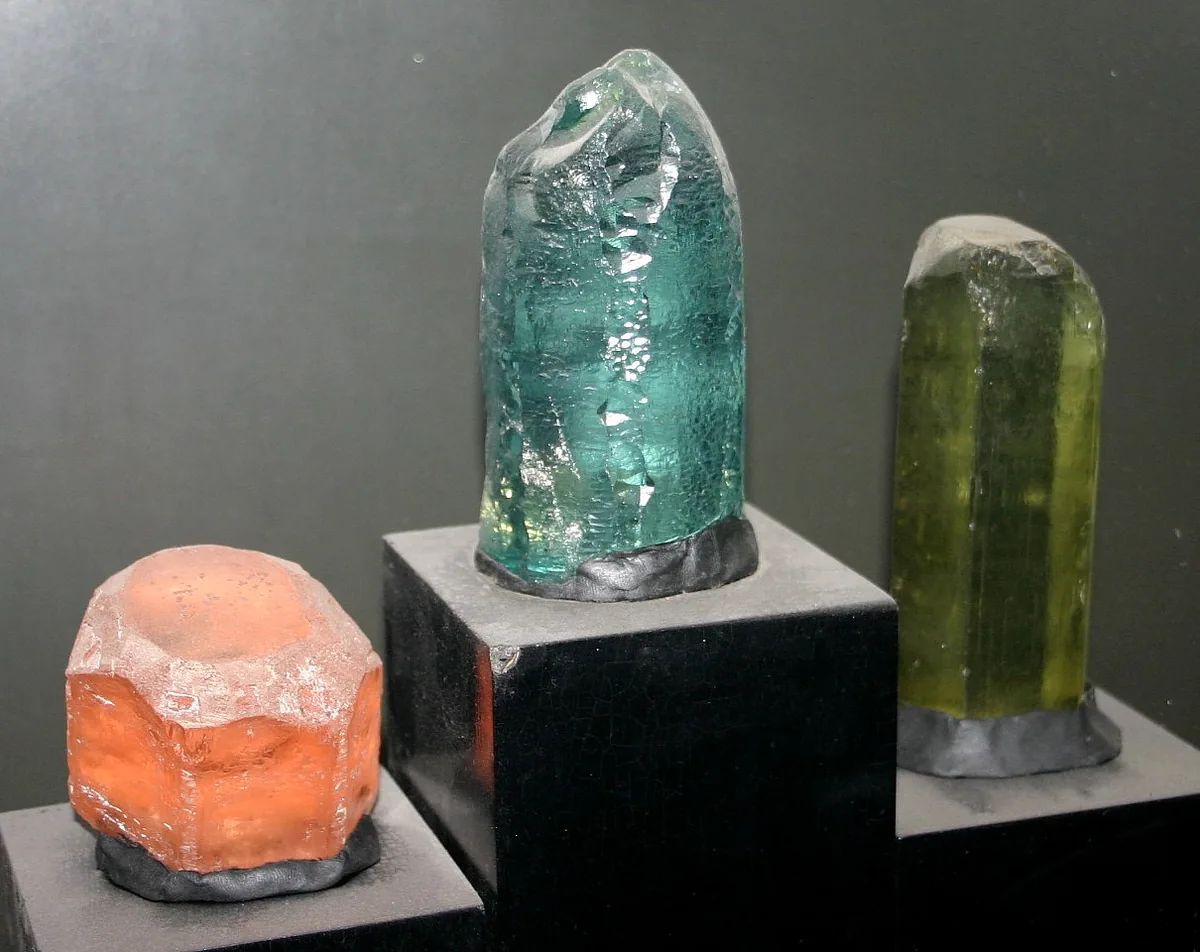
Beryl (Be₃Al₂Si₆O₁₈) is a beryllium aluminum cyclosilicate famous for its gem-variety daughters: aquamarine (blue), emerald (green from Cr/V), morganite (pink from Mn), heliodor (yellow from Fe), and goshenite (colorless). All are the same species — only trace-element coloration differs.
Beryl (Be₃Al₂Si₆O₁₈) is a beryllium aluminum cyclosilicate famous for its gem-variety daughters: aquamarine (blue), emerald (green from Cr/V), morganite (pink from Mn), heliodor (yellow from Fe), and goshenite (colorless). All are the same species — only trace-element coloration differs. Beryl forms in granitic pegmatites, hydrothermal veins, and metamorphic rocks; well-formed hexagonal prisms are the signature crystal habit.
Beryl is a parent species — the following named varieties differ in color or chemistry but share the same fundamental mineralogy.
Aquamarine(u6d77u84ddu5b9du77f3)
sky-blue to seawater-blue
Iron-bearing blue/blue-green beryl variety, named for sea water.
Emerald(u7956u6bcdu7eff)
rich green
Chromium- and vanadium-bearing green beryl variety; one of the four cardinal gems.
Morganite(u6469u6839u77f3)
pink to peach
Manganese-bearing pink to peach beryl variety, named for J.P. Morgan.
Heliodor(u91d1u7effu67f1u77f3)
golden-yellow
Iron-bearing golden-yellow beryl variety.
Goshenite(u900fu7effu67f1u77f3)
colorless
Pure colorless beryl variety, used for facetable gems.
Red Beryl(u7ea2u7effu67f1u77f3)
raspberry-red
Manganese-rich red beryl variety, extremely rare; almost exclusively from Utah USA.
About Beryl
Beryl belongs to the silicate class in the beryl group and has the chemical formula Al₂Be₃(Si₆O₁₈). It crystallizes in the hexagonal system and is one of the most visually varied minerals in the collector market. Its combination of structural character and global distribution make it a recognized species in both systematic and aesthetic collections.
Identification & care
Specimens usually show long hexagonal prisms with flat terminations; massive. Its color range is broad, including colorless (goshenite), green (emerald), blue-green (aquamarine), pink (morganite), yellow (heliodor), and red (red beryl/bixbite). The luster is vitreous, the streak is white, and specimens range from transparent to opaque. The cleavage is imperfect basal {0001}. The fracture is conchoidal to uneven, which aids identification.
Collector context
How it forms
In terms of geology, Beryl forms in granitic pegmatites; hydrothermal veins; metamorphic rocks (emerald in schist). It is commonly found in association with quartz, tourmaline, topaz, muscovite, feldspar, cassiterite.
Classic Chinese localities
Documented Chinese occurrences are recorded at Jinduicheng Mine, Xianghualing Sn-polymetallic ore field and Xihuashan ore field, among others.
Why collectors care
Collectors pursue Beryl for its patterns, color depth, and polish response rather than for pattern character. Good material has a surface that polishes cleanly, a visual character that holds up in direct light, and enough size to anchor a display on its own. Chinese sources, where present, supply much of the material currently cut and sold as decorative pieces.
What affects value
Value in Beryl is assessed, in typical order of weight, against: (1) source locality; (2) size; (3) pattern and visual character; (4) color depth and distribution; (5) polish response and surface finish; (6) piece integrity (absence of major cracks or chips). Uniqueness of pattern and verified source region add significantly to decorative pieces.
Frequently asked questions
What is Beryl?
Beryl has the chemical formula Be3Al2Si6O18, crystallises in the Hexagonal system, has a Mohs hardness of 7.5–8. Beryl is a silicate mineral prized by collectors for its exceptional color range, with several world-class Chinese localities.
What is the chemical formula of Beryl?
The chemical formula of Beryl is Be3Al2Si6O18.
What crystal system does Beryl belong to?
Beryl crystallises in the Hexagonal crystal system.
Is Beryl rare?
As a collector mineral, Beryl is generally considered uncommon.
Our inventory is one-of-a-kind and turns over quickly. Tell us what you're after — species, size, budget — and we'll notify you when a matching Beryl arrives from our sourcing network.
We use a small set of cookies (analytics, checkout, chat) to keep the site working and understand how visitors use it. Checkout-essential cookies are always loaded. Privacy policy