
Crocoite

Crystal system · Monoclinic

Crocoite is a chromate mineral recognized among collectors for its crystal form and distribution, with known Chinese sources.

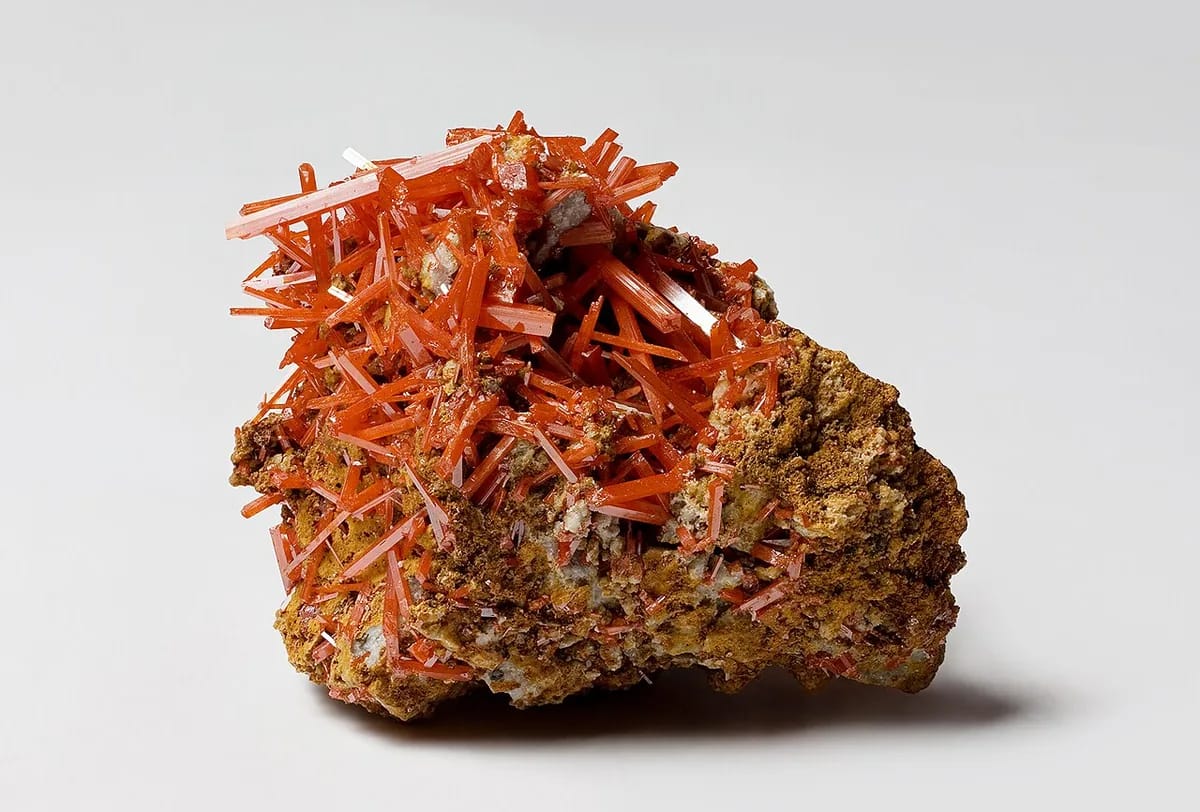
Crocoite specimen
Photo: JJ Harrison (https://www.jjharrison.com.au/) · CC BY-SA 2.5 via Wikimedia Commons

About Crocoiteextended article

Market availability: Rare
Sought after; limited supply. Major shows and specialist dealers only.
Collector tier: Cabinet Classic
World-class display species — sought after for cabinet collections, well-documented localities, frequent show-piece pieces.
Geological setting
Oxidation zone
Crystal system
Monoclinic

Crocoite is a lead chromate mineral whose vivid orange-to-red prismatic crystals from Tasmania rank among the most spectacular collector minerals on Earth. Crocoite from the Adelaide and Red Lead mines (Dundas, Tasmania) is the official mineral emblem of Tasmania.

Occurrence

Type locality: Berezovsk (Ural Mountains, Russia) — historic but small crystals. The unrivaled collector locality is Dundas, Tasmania (Adelaide, Red Lead, West Comet mines), where bright orange prisms up to 20 cm long form spectacular cavity-lining clusters.

Identification

Vivid orange-red elongated prismatic crystals + association with Pb oxidation zones + bright orange streak. Color is essentially diagnostic. Distinguish from realgar (also orange-red but sulfide, softer, sectile). Care: brittle and cleaves easily.

Collector Notes

Dundas crocoite clusters are signature Australian collector pieces and command premium prices. Often paired with cerussite, pyromorphite and dundasite. Closes the orange-red secondary-Pb mineral suite.
Export:BibTeXRIS
External research links for Crocoite
Published: May 6, 2026 · Last reviewed: May 6, 2026
Editorial standards & sources →

About Crocoite

Crocoite is classified as a chromate mineral in the monazite group (structural analogue) and has the chemical formula PbCrO4. It crystallizes in the monoclinic system and is relatively soft, requiring careful handling. Its combination of structural character and global distribution make it a recognized species in both systematic and aesthetic collections.

Identification & care

Crocoite typically forms prismatic elongated crystals, striated; often hollow; drusy crusts; acicular. Its color is typically bright orange-red to orange-yellow. The luster is adamantine, vitreous, the streak is orange-yellow, and specimens range from transparent to translucent. The cleavage is distinct on {110}, imperfect on {001}. The fracture is conchoidal, uneven, which aids identification.

Collector context

How it forms

In terms of geology, Crocoite forms in secondary mineral in oxidized zone of lead ore deposits that have been enriched in chromium; rare because both lead and chromium must be present simultaneously in the oxidized zone. It is commonly found in association with cerussite, wulfenite, mimetite, pyromorphite, galena, limonite, vauquelinite.

Classic Chinese localities

Crocoite has known Chinese occurrences in Gansu.

Why collectors care

Collectors pursue Crocoite for the clarity of its crystal form and, in good material, saturated color that reads instantly across a display case. A well-terminated crocoite on clean matrix photographs well, identifies quickly, and anchors a cabinet piece. Top Chinese specimens over the last two decades have reset the bar for what crocoite looks like at collector grade.

What affects value

Value in Crocoite is assessed, in typical order of weight, against: (1) locality provenance; (2) size relative to the species norm; (3) crystal form and termination sharpness; (4) color saturation and zoning; (5) transparency and internal clarity; (6) matrix quality and aesthetic balance; (7) condition (absence of damage, chips, or repair). Cleaning quality and verified locality documentation act as multipliers across the above.

Naming history

The name Crocoite has a specific etymological and historical context — see Mindat's reference entry for provenance details. We have retained naming data at the record level; published prose is paraphrased from factual fields rather than copied from source.

Frequently asked questions

What is Crocoite?

Crocoite is a chromate mineral recognized among collectors for its crystal form and distribution, with known Chinese sources.

What is the chemical formula of Crocoite?

The chemical formula of Crocoite is PbCrO4.

What crystal system does Crocoite belong to?

Crocoite crystallises in the Monoclinic crystal system.

Is Crocoite rare?

As a collector mineral, Crocoite is generally considered rare.

References & databases

Mindat.org is the world’s largest open mineralogy database. Our descriptions are written independently and fact-checked.