
Hornblende

Crystal system · Monoclinic

Hornblende is a silicate mineral recognized among collectors for its crystal form and distribution, with several world-class Chinese localities.

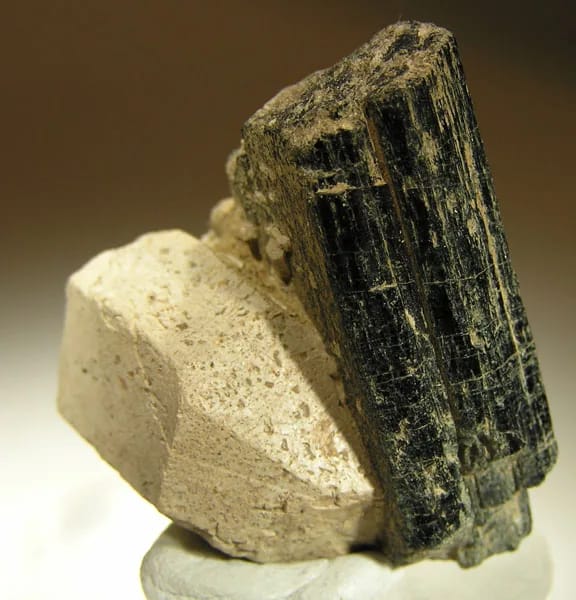
Hornblende specimen
Photo: Robert M. Lavinsky · CC BY-SA 3.0 via Wikimedia Commons

About Hornblendeextended article

Elemental Composition (by mass)
ElementMass %Visual
O Oxygen45.10%
Si Silicon28.79%
Mg Magnesium15.57%
Ca Calcium10.27%
H Hydrogen0.26%
Computed from simplified end-member formula. Solid-solution series, water content, and trace substitutions cause real-world variation.
IMA Abbreviation (Whitney-Evans 2010)
Hbl
→ Hornblende
Common amphibole
Standard symbol from American Mineralogist (Whitney & Evans, 2010). Used in thin-section labeling, phase diagrams, and IMA-style species records.
Pronunciation
/ˈhɔːrnblɛnd/
HORN-blend
German "horn deceiver"
Diaphaneity (Transparency)
opaque
Dark color makes most hornblende opaque.
Type Locality
Hesse — Germany
Described 1789 by Werner (German "horn-stone")
Magnetism
Category:
weakly paramagnetic
Test result:
Detectable
Fe-bearing complex amphibole.
Test with rare-earth magnet (N42 or N52 neodymium). Suspend specimen on thread for sensitive paramagnetic detection. Diamagnetic minerals are weakly repelled (visible only with strong magnets like bismuth).
Cleavage & Fracture
Cleavage:
perfect 2 directions ~56°/124°
Fracture:
uneven
Diagnostic 56° cleavage angle vs pyroxene 90°.
Collector tier: Micromount / Niche
Best appreciated at thumbnail or smaller scale — often dull-colored, sub-millimeter, or radioactive. Specialist appeal.
Mohs 5–6
Vickers (~) 540 HV
Knoop (~) 620 HK
Geological setting
VolcanicPlutonic igneousMetamorphic
Element composition by mass

Formula: Ca₂(Mg,Fe,Al)₅(Al,Si)₈O₂₂(OH)₂ · molar mass: 864.97 g/mol

O 44.39%
Al 17.68%
Si 12.99%
Fe 10.76%
Ca 9.27%
Mg 4.68%
H 0.23%

Computed from atomic weights (IUPAC 2021). Site-occupancy groups (Fe,Mn) split equally.

GroupAmphibole Group
Related members: Tremolite · Actinolite
Mohs Hardness 5–6

Hornblende sits at 5–6 on the Mohs scale — just hard enough to scratch glass.

Colors:
Streak
Gray-green to brown
Crystal system
Monoclinic
SilicatesSilicates (Inosilicates — Amphiboles)
TL;DR · 1 min read
Hornblende is a complex calcic amphibole series — not a single species but a name historically applied to dark green-black amphiboles in igneous and metamorphic rocks. It is one of the most abundant rock-forming minerals on Earth.

Hornblende is a complex calcic amphibole series — not a single species but a name historically applied to dark green-black amphiboles in igneous and metamorphic rocks. It is one of the most abundant rock-forming minerals on Earth. Modern IMA classification splits Hornblende into magnesio-hornblende and ferro-hornblende endmembers, but the classical “Hornblende” name remains in widespread use.

More minerals to explore

About Hornblende

Hornblende is classified as a silicate mineral in the amphibole group — calcic amphiboles and has the chemical formula (Ca,Na)2-3(Mg,Fe,Al)5(Al,Si)8O22(OH)2. It crystallizes in the monoclinic system and holds a steady position among silicate species. Its combination of structural character and global distribution make it a recognized species in both systematic and aesthetic collections.

Identification & care

Specimens usually show prismatic, elongated, bladed, massive, columnar. Its color is typically black, dark green and dark brown. The luster is vitreous to silky, the streak is white to gray, and specimens range from translucent to opaque. The cleavage is perfect {110} at 56° and 124° (diagnostic amphibole cleavage angle). The fracture is uneven, which aids identification.

Collector context

How it forms

The geological setting for Hornblende is typically primary mineral in intermediate and mafic igneous rocks (diorite, andesite, gabbro, basalt); metamorphic amphibolites and hornblende schists. It is commonly found in association with plagioclase, augite, biotite, quartz, magnetite.

Classic Chinese localities

Huanggang Fe-Sn deposit is an important Chinese source for the species.

Why collectors care

Hornblende is a frequently-sought species in serious collections because its habit is recognizable, its color often strong, and its best examples unmistakable even at a distance. Chinese material has driven much of the recent visual shift in the species — sharper crystals, deeper colors, cleaner matrix.

What affects value

Value in Hornblende is assessed, in typical order of weight, against: (1) locality provenance; (2) size relative to the species norm; (3) crystal form and termination sharpness; (4) color saturation and zoning; (5) transparency and internal clarity; (6) matrix quality and aesthetic balance; (7) condition (absence of damage, chips, or repair). Cleaning quality and verified locality documentation act as multipliers across the above.

Naming history

The name Hornblende has a specific etymological and historical context — see Mindat's reference entry for provenance details. We have retained naming data at the record level; published prose is paraphrased from factual fields rather than copied from source.

Frequently asked questions

What is Hornblende?

Hornblende is a silicate mineral recognized among collectors for its crystal form and distribution, with several world-class Chinese localities.

What is the chemical formula of Hornblende?

The chemical formula of Hornblende is Ca2Mg5Si8O22H2.

What crystal system does Hornblende belong to?

Hornblende crystallises in the Monoclinic crystal system.

References & databases

Mindat.org is the world’s largest open mineralogy database. Our descriptions are written independently and fact-checked.