
Smithsonite

Crystal system · Trigonal

Smithsonite is a carbonate mineral prized by collectors for its exceptional color range, with notable Chinese occurrences.

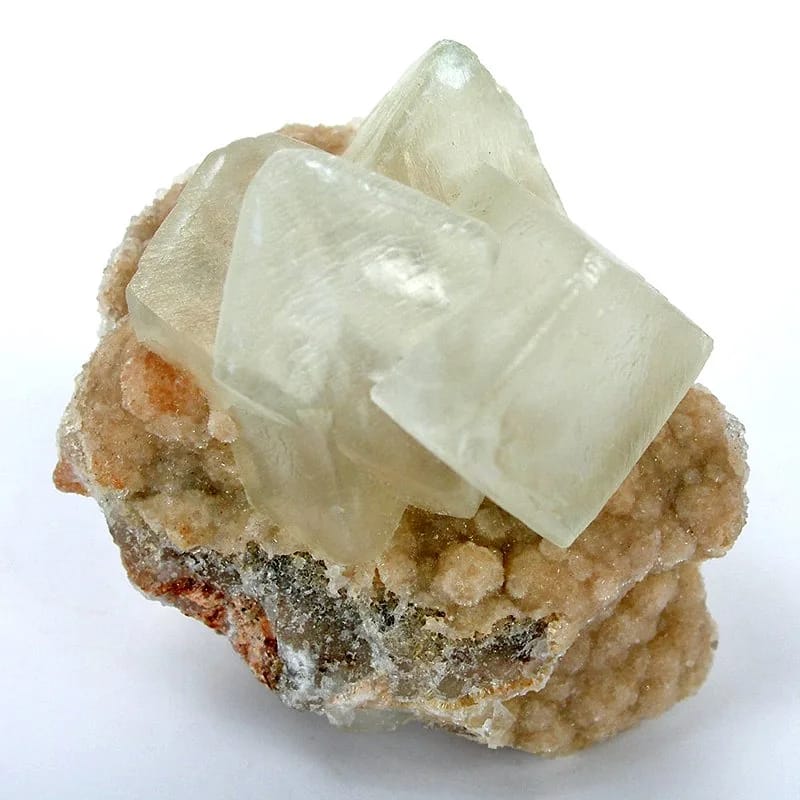
Smithsonite specimen
Photo: Robert M. Lavinsky · CC BY-SA 3.0 via Wikimedia Commons

About Smithsoniteextended article

China-iconic

China is a defining locality for Smithsonite · 菱锌矿. See the Chinese collector page →

Elemental Composition (by mass)
ElementMass %Visual
Zn Zinc52.14%
O Oxygen38.28%
C Carbon9.58%
Computed from simplified end-member formula. Solid-solution series, water content, and trace substitutions cause real-world variation.
IMA Abbreviation (Whitney-Evans 2010)
Smt
→ Smithsonite
Zn carbonate
Standard symbol from American Mineralogist (Whitney & Evans, 2010). Used in thin-section labeling, phase diagrams, and IMA-style species records.
Pronunciation
/ˈsmɪθsənaɪt/
SMITH-suh-nite
for J. Smithson
Collector tier: Solid Display
Reliable mid-tier display species. Easy to find in well-formed examples; broad locality diversity.
Mohs 4–4.5
Vickers (~) 200 HV
Knoop (~) 220 HK
Nickel–Strunz 5.AB.05
Dana 14.01.01.07
Element composition by mass

Formula: ZnCO₃ · molar mass: 125.39 g/mol

Zn 52.14%
O 38.28%
C 9.58%

Computed from atomic weights (IUPAC 2021). Site-occupancy groups (Fe,Mn) split equally.

Mohs Hardness 4–4.5

Smithsonite sits at 4–4.5 on the Mohs scale — can be scratched by a steel knife.

Colors:
Streak
White
Crystal system
Trigonal
Type localityKelmis, Belgium / Tsumeb, Namibia
CarbonatesCarbonates
TL;DR · 1 min read
Smithsonite (ZnCO₃) is a secondary zinc carbonate that forms in the oxidized cap of zinc-lead deposits. It is famous for botryoidal, grape-like crystal habits in saturated colors — apple green, sky blue, lavender pink, and lemon yellow.

Smithsonite (ZnCO₃) is a secondary zinc carbonate that forms in the oxidized cap of zinc-lead deposits. It is famous for botryoidal, grape-like crystal habits in saturated colors — apple green, sky blue, lavender pink, and lemon yellow. Yunnan and Guangxi host significant Chinese deposits.

Notable Chinese Localities

Yunnan and Guangxi host pink and blue-green smithsonite. Hunan yields grayish-blue botryoidal specimens.

Cite this entry
APA
MyMineralBox Editorial Team. (2026). Smithsonite. My Mineral Box. Retrieved May 23, 2026, from https://mymineralbox.com/mineral-encyclopedia/minerals/smithsonite/
MLA
MyMineralBox Editorial Team. "Smithsonite." My Mineral Box, 2026, https://mymineralbox.com/mineral-encyclopedia/minerals/smithsonite/. Accessed May 23, 2026.
Chicago
MyMineralBox Editorial Team. "Smithsonite." My Mineral Box. Last modified May 4, 2026. https://mymineralbox.com/mineral-encyclopedia/minerals/smithsonite/.
BibTeX
@misc{mmb_smithsonite,
 author = {{MyMineralBox Editorial Team}},
 title = {{Smithsonite}},
 year = {2026},
 publisher = {My Mineral Box},
 url = {https://mymineralbox.com/mineral-encyclopedia/minerals/smithsonite/},
 urldate = {2026-05-23}
}

About Smithsonite

Smithsonite belongs to the carbonate class in the calcite group and has the chemical formula ZnCO₃. It crystallizes in the trigonal system and is one of the most visually varied minerals in the collector market. Its combination of structural character and global distribution make it a recognized species in both systematic and aesthetic collections.

Identification & care

Crystals commonly develop as rhombohedral; botryoidal (grape-like); stalactitic; massive; rarely sharp crystals. Its color range is broad, including blue, green, pink, yellow, orange, white, gray, and lavender. The luster is vitreous, pearly, the streak is white, and specimens range from transparent to translucent. The cleavage is perfect rhombohedral {1011}. The fracture is uneven to conchoidal, which aids identification.

Collector context

How it forms

Smithsonite forms in secondary mineral in oxidized zones of zinc ore deposits. It is commonly found in association with sphalerite, galena, calcite, malachite, azurite, hemimorphite.

Classic Chinese localities

Documented Chinese occurrences are recorded at Dabaoshan Mine, among others.

Why collectors care

Smithsonite is a frequently-sought species in serious collections because its habit is recognizable, its color often strong, and its best examples unmistakable even at a distance. Chinese material has driven much of the recent visual shift in the species — sharper crystals, deeper colors, cleaner matrix.

What affects value

Value in Smithsonite is assessed, in typical order of weight, against: (1) locality provenance; (2) size relative to the species norm; (3) crystal form and termination sharpness; (4) color saturation and zoning; (5) transparency and internal clarity; (6) matrix quality and aesthetic balance; (7) condition (absence of damage, chips, or repair). Cleaning quality and verified locality documentation act as multipliers across the above.

Naming history

The name Smithsonite has a specific etymological and historical context — see Mindat's reference entry for provenance details. We have retained naming data at the record level; published prose is paraphrased from factual fields rather than copied from source.

Frequently asked questions

What is Smithsonite?

Smithsonite is a carbonate mineral prized by collectors for its exceptional color range, with notable Chinese occurrences.

What is the chemical formula of Smithsonite?

The chemical formula of Smithsonite is ZnCO3.

What crystal system does Smithsonite belong to?

Smithsonite crystallises in the Trigonal crystal system.

Where is Smithsonite found?

Notable localities for Smithsonite include Tsumeb.

References & databases

Mindat.org is the world’s largest open mineralogy database. Our descriptions are written independently and fact-checked.