
Elemental Composition (by mass)
| Element | Mass % | Visual |
|---|---|---|
| K Potassium | 52.45% | |
| Cl Chlorine | 47.55% |
Computed from simplified end-member formula. Solid-solution series, water content, and trace substitutions cause real-world variation.
IMA Abbreviation (Whitney-Evans 2010)
Syl
→ Sylvite
KCl
Standard symbol from American Mineralogist (Whitney & Evans, 2010). Used in thin-section labeling, phase diagrams, and IMA-style species records.
⏳ Long-term Aging & Care Timeline
deliquescencedays to weeks
Trigger: humidity > 70%
Intervention: Faster than halite. Sealed dry storage required.
Pronunciation
/ˈsɪlvaɪt/
↔ SIL-vite
for F. Sylvius
⚠ Safety & Handling
💧water-sensitivehigh
Same as halite.
Handling: Sealed case with desiccant.
Information provided in good faith. Consult local hazmat regulations for transport and disposal. Severely hazardous specimens may require special storage cabinets.
Diaphaneity (Transparency)
transparent-to-translucent
K-bearing halide.
Diagnostic Field Tests
Taste test→ Bitter (salty + bitter potassium)
Distinctly different from halite — sharper, bitter.
⚠ Use dilute HCl (~10%) only on inconspicuous spots; rinse promptly. Smell-tests should be brief and ventilated. Taste-test ONLY halite/sylvite — never lead, arsenic, or sulfur minerals.
Mohs 2
Vickers (~) 75 HV
Knoop (~) 85 HK
Geological setting
SedimentaryEvaporite
Element composition by mass
Formula: KCl · molar mass: 74.55 g/mol
| K | 52.45% | |
| Cl | 47.55% |
Computed from atomic weights (IUPAC 2021). Site-occupancy groups (Fe,Mn) split equally.
Mohs Hardness
2
Sylvite sits at 2 on the Mohs scale — soft enough to be scratched by a fingernail.
Colors:
Streak
White
White
Crystal system
Isometric (Cubic)
Isometric (Cubic)
HalidesHalides
TL;DR · 1 min read
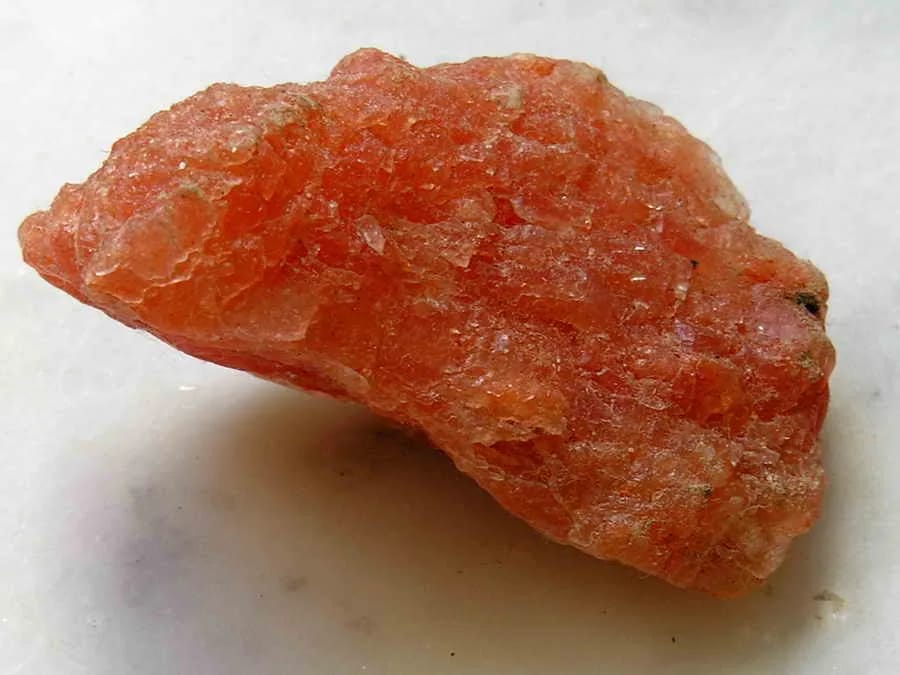
Sylvite (KCl) is potassium chloride — the principal potash mineral and a major fertilizer ore. It crystallizes in evaporite sequences alongside halite, often with reddish color from hematite inclusions. Saskatchewan (Canada) and Solikamsk (Russia) host the world’s largest sylvinite deposits. Distinguished from halite by bitter taste (vs. halite’s salty taste).