Wulfenite

Crystal system · Tetragonal

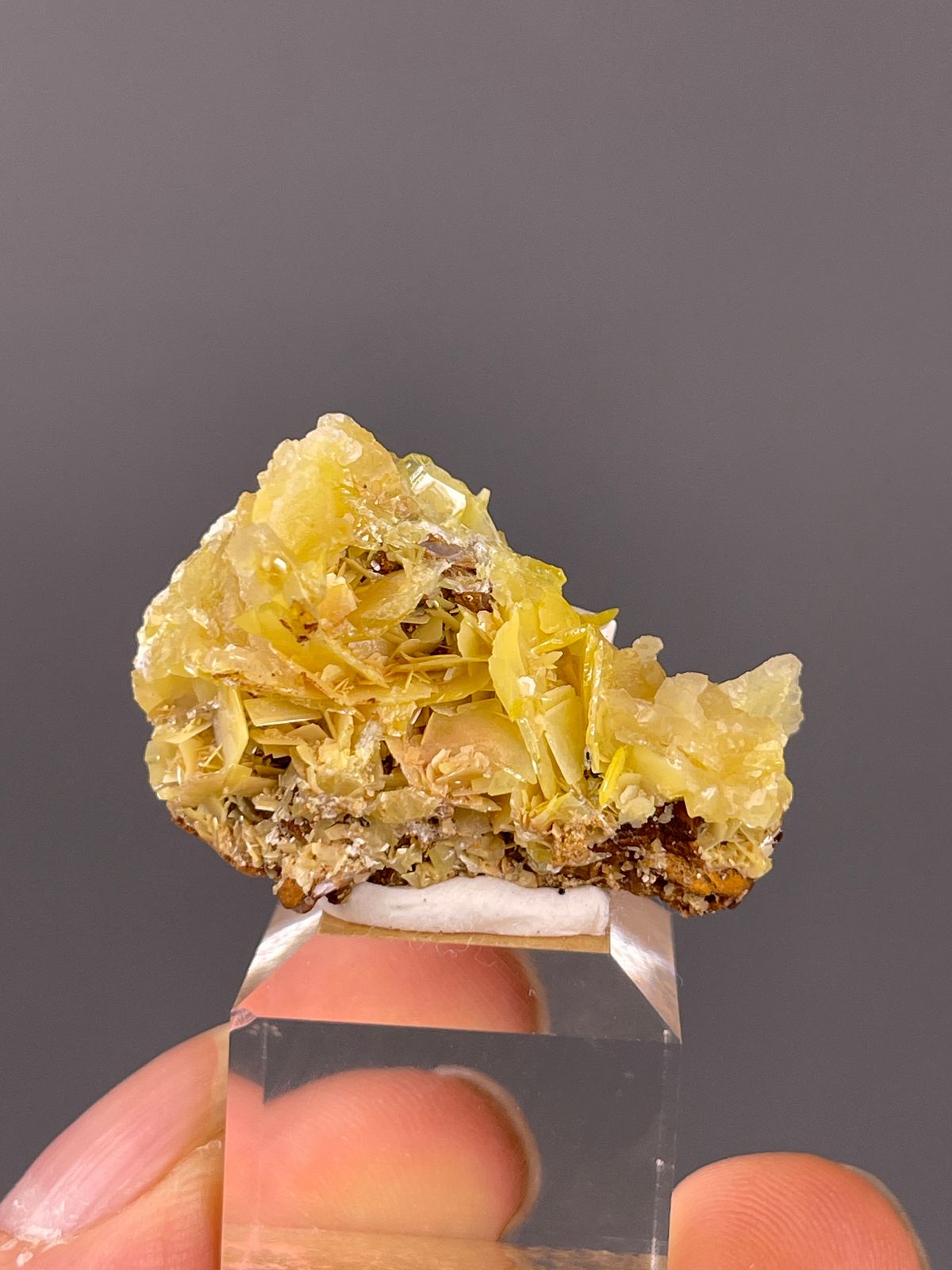
Wulfenite is a molybdate mineral prized by collectors for its exceptional color range, with notable Chinese occurrences.

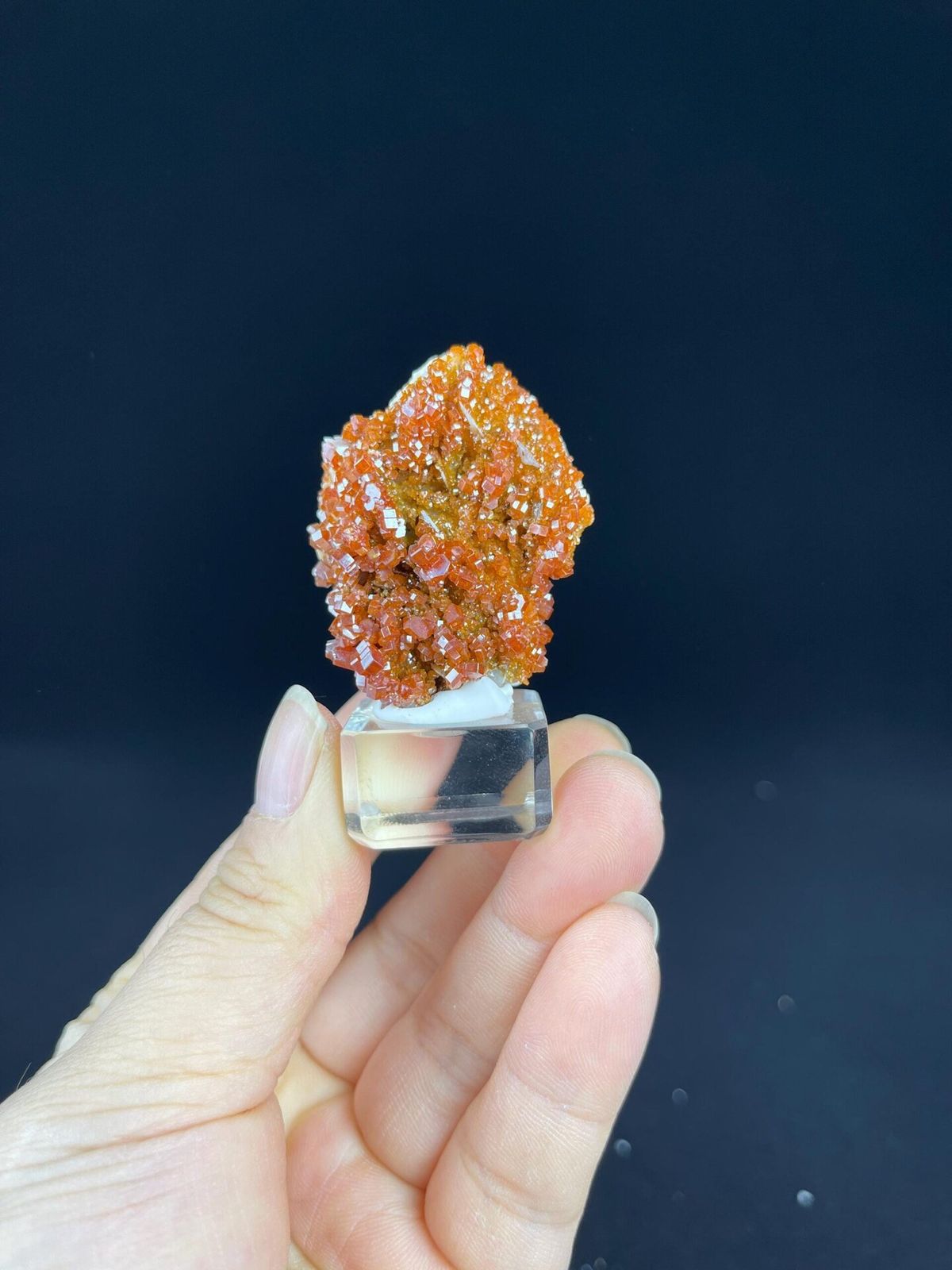
Front view of vibrant red-orange wulfenite cluster from Morocco

About Wulfeniteextended article

Elemental Composition (by mass)
ElementMass %Visual
Pb Lead56.44%
Mo Molybdenum26.13%
O Oxygen17.43%
Computed from simplified end-member formula. Solid-solution series, water content, and trace substitutions cause real-world variation.
IMA Abbreviation (Whitney-Evans 2010)
Wul
→ Wulfenite
Pb molybdate
Standard symbol from American Mineralogist (Whitney & Evans, 2010). Used in thin-section labeling, phase diagrams, and IMA-style species records.
Pronunciation
/ˈwʊlfənaɪt/
WOOLF-uh-nite
for F.X. von Wulfen
⚠ Safety & Handling
toxicmoderate
Lead molybdate.
Handling: Wash hands.
Information provided in good faith. Consult local hazmat regulations for transport and disposal. Severely hazardous specimens may require special storage cabinets.
Tenacity
Behavior:
brittle (fragile)
Under stress:
Thin plates chip easily
Tabular crystals very thin; chip on edges.
Luster
adamantineresinous
Bright orange-yellow with characteristic adamantine sparkle.
Type Locality
Bleiberg — Austria
Described 1845 by Haidinger (named for F.X. von Wulfen)
Care notesLight-sensitive (some specimens fade). Avoid acid cleaning. Full cleaning guide →
Market availability: Uncommon
Found at major shows and select dealers. Quality varies by locality.
Collector tier: Cabinet Classic
World-class display species — sought after for cabinet collections, well-documented localities, frequent show-piece pieces.
Mohs 2.5–3
Vickers (~) 170 HV
Knoop (~) 185 HK
Nickel–Strunz 7.GA.05
Dana 48.02.04.01
Geological setting
Oxidation zone
Element composition by mass

Formula: PbMoO₄ · molar mass: 367.15 g/mol

Pb 56.44%
Mo 26.13%
O 17.43%

Computed from atomic weights (IUPAC 2021). Site-occupancy groups (Fe,Mn) split equally.

Mohs Hardness 2.5–3
1
Talc
2
Gypsum
3
Calcite
4
Fluorite
5
Apatite
6
Orthoclase
7
Quartz
8
Topaz
9
Corundum
10
Diamond

Wulfenite sits at 2.5–3 on the Mohs scale — can be scratched by a steel knife.

Colors:
Streak
White
Crystal system
Tetragonal
Pronunciation/ˈwʊlfənaɪt/
Type localityBad Bleiberg, Carinthia, Austria
Discovery First described 1845 by Wilhelm Karl Ritter von Haidinger (Carinthia)
MolybdatesMolybdates
TL;DR · 1 min read
Wulfenite (PbMoO₄) is a lead-molybdate mineral famous for its bright orange, yellow, and red square tabular crystals. The most prized Wulfenite specimens — saturated honey-orange paper-thin tablets from Red Cloud Mine (Arizona) and Mibladen (Morocco) — are among the most photographed minerals in collector literature.

Wulfenite (PbMoO₄) is a lead-molybdate mineral famous for its bright orange, yellow, and red square tabular crystals. The most prized Wulfenite specimens — saturated honey-orange paper-thin tablets from Red Cloud Mine (Arizona) and Mibladen (Morocco) — are among the most photographed minerals in collector literature. China hosts modest Wulfenite occurrences at Yongping (Jiangxi).

More minerals to explore

About Wulfenite

Wulfenite is a molybdate mineral in the scheelite group and has the chemical formula Pb(MoO₄). It crystallizes in the tetragonal system and is one of the most visually varied minerals in the collector market. Its combination of structural character and global distribution make it a recognized species in both systematic and aesthetic collections.

Identification & care

Wulfenite typically forms tabular square platelets (often paper-thin); pyramidal; massive. Its color range is broad, including orange, orange-red, yellow, honey-yellow, gray, brown, white, and olive-green. The luster is adamantine, resinous, sub-adamantine, the streak is white, and specimens range from transparent to translucent. The cleavage is distinct on {001}. The fracture is uneven to conchoidal, which aids identification.

Collector context

How it forms

The geological setting for Wulfenite is typically secondary mineral in oxidized zones of lead ore deposits. It is commonly found in association with mimetite, cerussite, vanadinite, dioptase, fluorite, calcite.

Classic Chinese localities

Dexing Cu-Mo-Au ore field is an important Chinese source for the species.

Why collectors care

Wulfenite is a frequently-sought species in serious collections because its habit is recognizable, its color often strong, and its best examples unmistakable even at a distance. Chinese material has driven much of the recent visual shift in the species — sharper crystals, deeper colors, cleaner matrix.

What affects value

Value in Wulfenite is assessed, in typical order of weight, against: (1) locality provenance; (2) size relative to the species norm; (3) crystal form and termination sharpness; (4) color saturation and zoning; (5) transparency and internal clarity; (6) matrix quality and aesthetic balance; (7) condition (absence of damage, chips, or repair). Cleaning quality and verified locality documentation act as multipliers across the above.

Naming history

The name Wulfenite has a specific etymological and historical context — see Mindat's reference entry for provenance details. We have retained naming data at the record level; published prose is paraphrased from factual fields rather than copied from source.

Frequently asked questions

What is Wulfenite?

Wulfenite is a molybdate mineral prized by collectors for its exceptional color range, with notable Chinese occurrences.

What is the chemical formula of Wulfenite?

The chemical formula of Wulfenite is Pb(MoO₄).

What crystal system does Wulfenite belong to?

Wulfenite crystallises in the Tetragonal crystal system.

Where is Wulfenite found?

Notable localities for Wulfenite include Tsumeb, Ojuela / Mapimí, Red Cloud Mine.

Is Wulfenite rare?

As a collector mineral, Wulfenite is generally considered uncommon.

References & databases

Mindat.org is the world’s largest open mineralogy database. Our descriptions are written independently and fact-checked.

Available Wulfenite specimens

1 specimen