
Elemental Composition (by mass)
| Element | Mass % | Visual |
|---|---|---|
| O Oxygen | 41.56% | |
| Si Silicon | 24.32% | |
| Fe Iron | 24.18% | |
| Na Sodium | 9.95% |
Computed from simplified end-member formula. Solid-solution series, water content, and trace substitutions cause real-world variation.
IMA Abbreviation (Whitney-Evans 2010)
Aeg
→ Aegirine
Na-Fe pyroxene
Standard symbol from American Mineralogist (Whitney & Evans, 2010). Used in thin-section labeling, phase diagrams, and IMA-style species records.
Pronunciation
/ˈiːdʒɪriːn/
↔ EE-jih-reen
for Aegir (Norse sea god)
Market availability: Common
Widely available in most dealer stocks. Specimens span all price tiers.
Collector tier: Micromount / Niche
Best appreciated at thumbnail or smaller scale — often dull-colored, sub-millimeter, or radioactive. Specialist appeal.
Mohs 6
Vickers (~) 820 HV
Knoop (~) 870 HK
Geological setting
Plutonic igneousPegmatiteCarbonatiteMetamorphic
Element composition by mass
Formula: NaFeSi₂O₆ · molar mass: 231 g/mol
| O | 41.56% | |
| Si | 24.32% | |
| Fe | 24.18% | |
| Na | 9.95% |
Computed from atomic weights (IUPAC 2021). Site-occupancy groups (Fe,Mn) split equally.
GroupPyroxene Group
Mohs Hardness
6
Aegirine sits at 6 on the Mohs scale — just hard enough to scratch glass.
Colors:
Streak
Gray-green
Gray-green
Crystal system
Monoclinic
Monoclinic
SilicatesSilicates (Inosilicates — Pyroxenes)
TL;DR · 1 min read
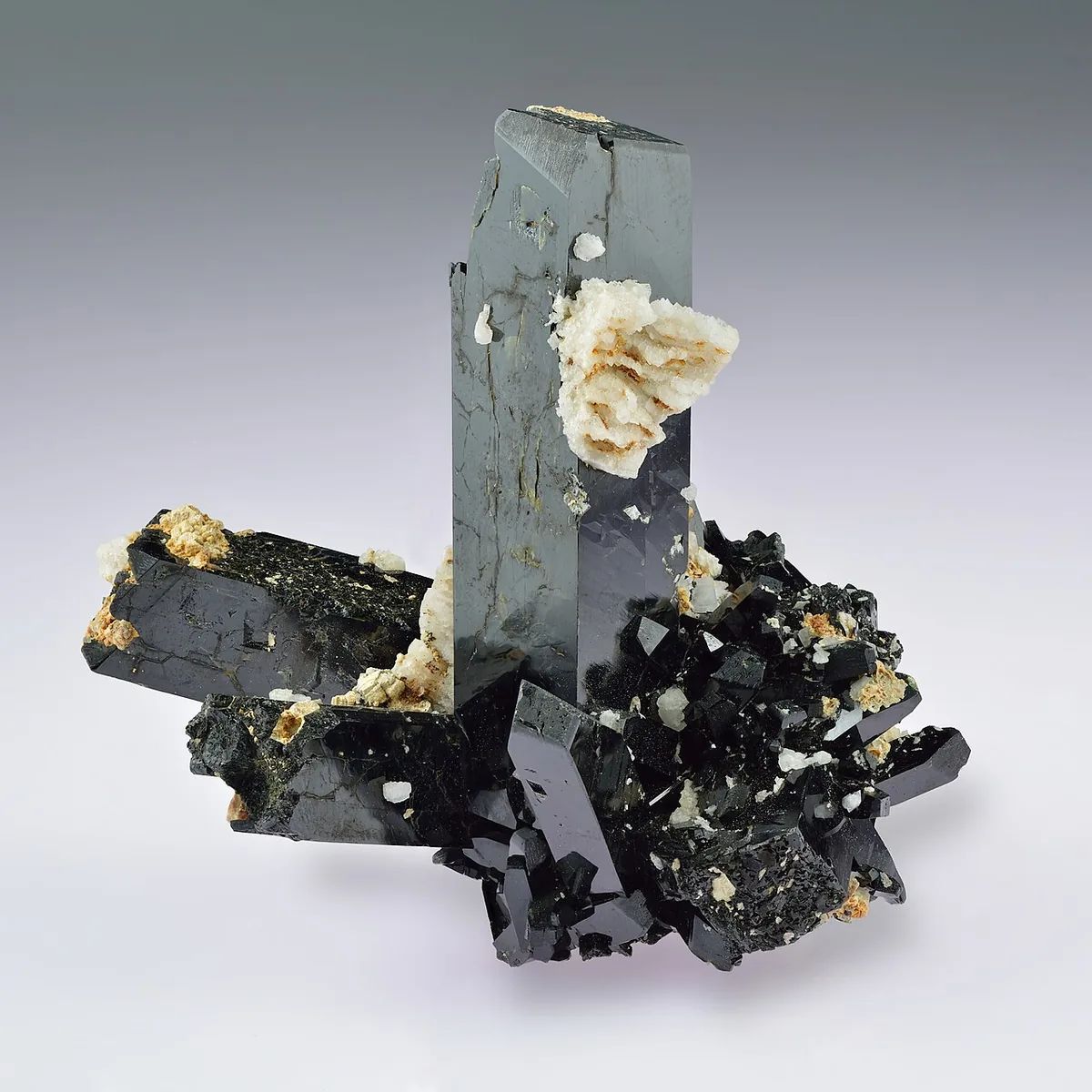
Aegirine (NaFeSi₂O₆) is the sodium-iron end-member of the alkali clinopyroxene group, forming long prismatic black to dark-green crystals in alkaline igneous rocks. The Mt.
Aegirine (NaFeSi₂O₆) is the sodium-iron end-member of the alkali clinopyroxene group, forming long prismatic black to dark-green crystals in alkaline igneous rocks. The Mt. Saint-Hilaire (Quebec) and Khibiny Massif (Russia) localities produce world-class aegirine on syenite and nepheline pegmatite matrix.