Crystal Structure
Variety of quartz — same structure as parent.
Elemental Composition (by mass)
| Element | Mass % | Visual |
|---|---|---|
| O Oxygen | 53.26% | |
| Si Silicon | 46.74% |
Computed from simplified end-member formula. Solid-solution series, water content, and trace substitutions cause real-world variation.
IMA Abbreviation (Whitney-Evans 2010)
Qz
→ Quartz
Variety of quartz; uses parent symbol
Standard symbol from American Mineralogist (Whitney & Evans, 2010). Used in thin-section labeling, phase diagrams, and IMA-style species records.
⏳ Long-term Aging & Care Timeline
color fade (very slow)decades
Trigger: intense sunlight
Intervention: Most amethyst color stable for normal display. Extreme sunlight over decades may lighten.
Pronunciation
/ˈæməθɪst/
↔ AM-uh-thist
three syllables (Greek)
Birthstone & Anniversary Gift Reference
January (zodiac) — zodiac: Capricorn / Aquarius
February (modern, traditional, zodiac) — zodiac: Aquarius / Pisces
› Full birthstones registry
UV Fluorescence
SW (254 nm)
—
none
LW (365 nm)
—
none
Inert.
SW = shortwave (germicidal lamp). LW = longwave (blacklight). Response varies with locality, trace impurities, and treatment.
Tenacity
Behavior:
brittle
Under stress:
Same as quartz
Same as quartz.
Luster
vitreous
Same as quartz parent.
Color Cause (Chromophore)
Chromophore:
Fe-induced color center
Mechanism:
natural irradiation of Fe-bearing quartz
Color produced:
purple
Color centers form when ionizing radiation excites trapped Fe³⁺/Fe⁴⁺ pairs. Heat destroys color center.
Diaphaneity (Transparency)
transparent
Gem-quality transparent; some massive material is translucent.
Type Locality
(known since antiquity) — Worldwide
› Browse all type localities
Magnetism
Category:
weakly paramagnetic
Test result:
Very slight pull (Fe color center)
Iron color center gives faint paramagnetism.
Test with rare-earth magnet (N42 or N52 neodymium). Suspend specimen on thread for sensitive paramagnetic detection. Diamagnetic minerals are weakly repelled (visible only with strong magnets like bismuth).
Specific Gravity
2.65
g/cm³
light
Same as quartz.
For comparison: water = 1.00, glass ≈ 2.5, quartz = 2.65, corundum ≈ 4.00, galena ≈ 7.50, gold ≈ 19.3.
Synthetics & Imitations
Lab-grown methods
Hydrothermal 1965 · Russian / Chinese
Difficult to distinguish from natural. Twinning patterns (Brazil-law) less common in synthetic — important diagnostic.
Common imitations
Purple glass
Singly refractive, no twinning, gas bubbles.
Synthetic corundum (purple)
Higher RI; doubly refractive.
Geological Setting
Environment:
hydrothermal
Host rock:
basalt geode, agate vug, hydrothermal vein
Companions:
Most amethyst forms in geode cavities within basaltic lavas (Brazil, Uruguay) or pegmatite veins (Ural, Madagascar).
Treatments & Enhancements
Heat treatmentoccasionalstable· detection: hard
Heating amethyst produces citrine. Most "citrine" on market is actually heated amethyst. Accepted with disclosure.
As a buyer: request written disclosure of treatments and confirm whether the price reflects treated or untreated material.
Characteristic Inclusions
Tiger-stripe zoninggrowth-pattern★ diagnostic
Brazil-law twinning creates alternating colorless/violet bands visible under crossed polars.
Goethite needlessolid
Hair-like dark brown FeO(OH) inclusions in some Brazilian material.
★ Diagnostic inclusions are characteristic enough to help identify origin or species under 10× loupe.
Twinning Laws
Brazil lawpenetration
Brazil-law twinning produces the characteristic "tiger-stripe" zoning in amethyst.
Dauphiné lawpenetration
Same 60° c-axis rotation as in rock crystal.
Care notesAvoid prolonged sun exposure — fades. Otherwise water-stable. Full cleaning guide →
Formation eraHydrothermal cavity filling; Rio Grande do Sul geodes 130 Ma volcanic.
Pleochroism (dichroic)
Axis o
red-violet
Axis e
blue-violet
Strength: weak
Subtle but present; sometimes called "doubly refractive amethyst" effect.
Cleavage & Fracture
Cleavage:
none —
Fracture:
conchoidal
No cleavage; conchoidal fracture as in all quartz.
Market availability: Common
Widely available in most dealer stocks. Specimens span all price tiers.
Collector tier: Cabinet Classic
Display species collected for cabinet presentation, with specimens recorded from named localities.
Mohs 7
Vickers (~) 1400 HV
Knoop (~) 1100 HK
Geological setting
Volcanic
Element composition by mass
Formula: SiO₂ (quartz var.) · molar mass: 60.08 g/mol
| O | 53.26% | |
| Si | 46.74% |
Computed from atomic weights (IUPAC 2021). Site-occupancy groups (Fe,Mn) split equally.
GroupQuartz Group (silica)
Mohs Hardness
7
Amethyst sits at 7 on the Mohs scale — harder than glass; scratches steel.
Colors:
Streak
White
White
Crystal system
Trigonal
Trigonal
Pronunciation/ˈæməθɪst/
Oxides & HydroxidesOxides (Silica Group)
TL;DR · 1 min read
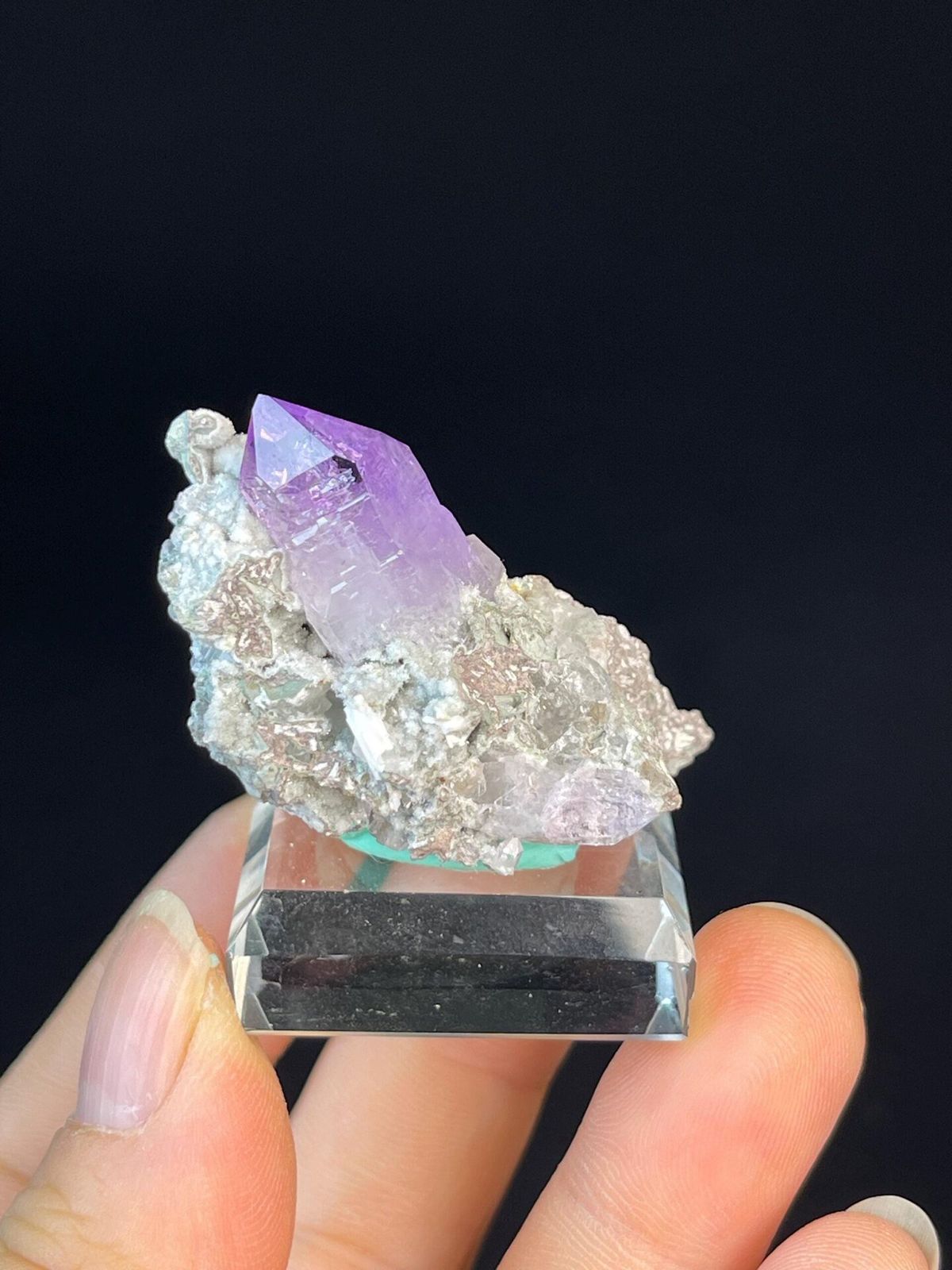
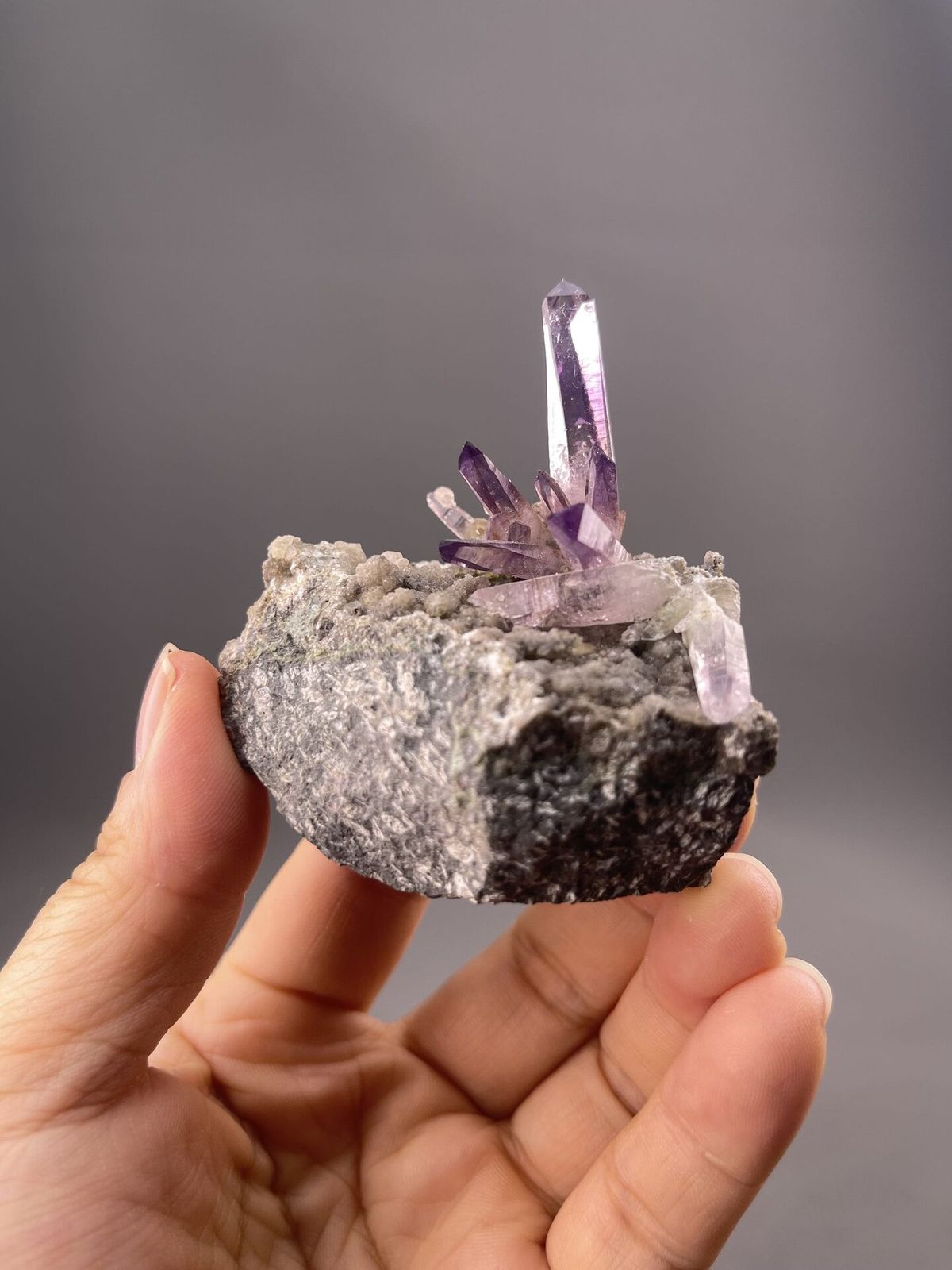
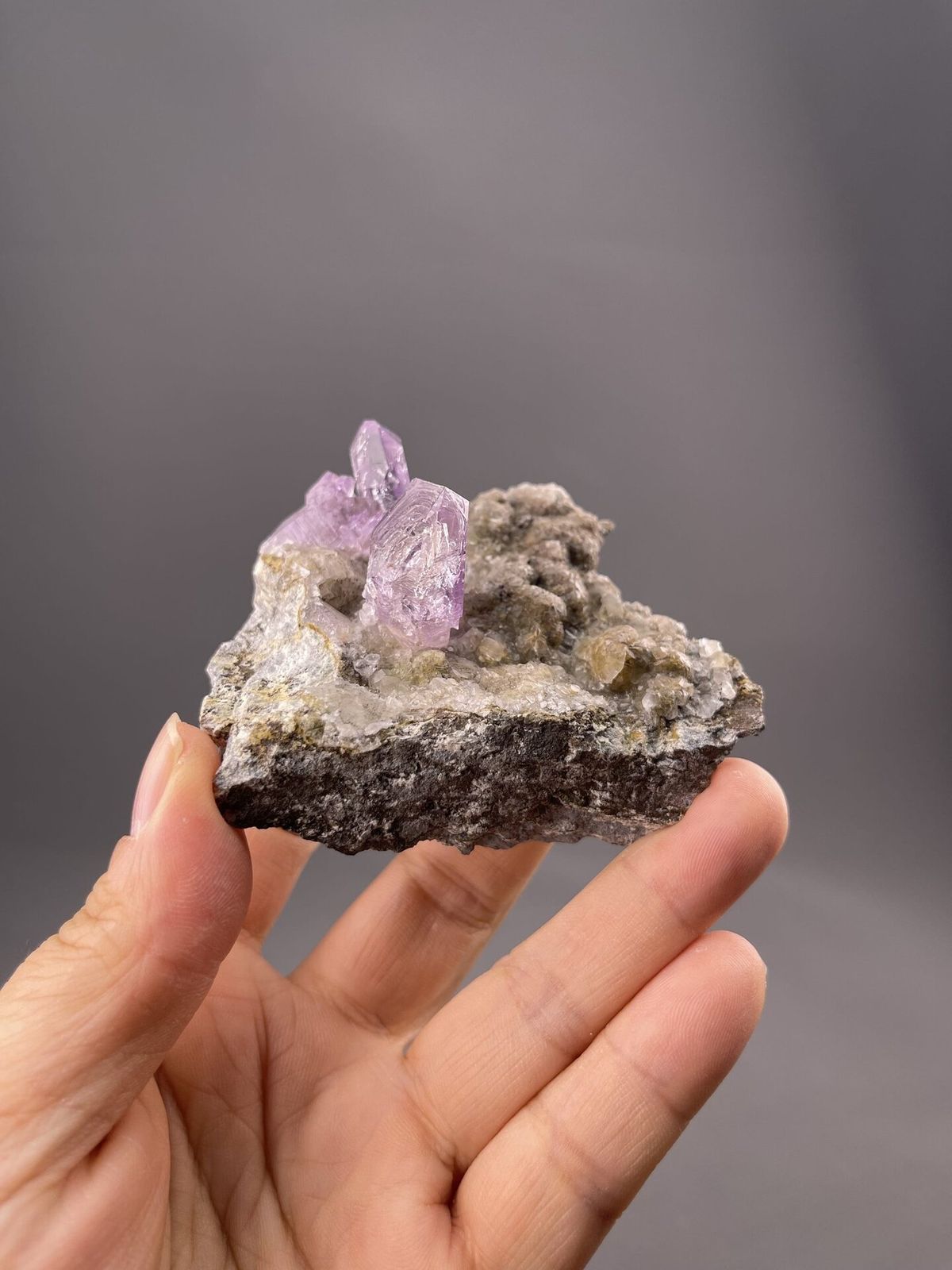
Amethyst is the violet to purple variety of quartz (SiO₂) colored by trace iron and natural irradiation. The February birthstone, Amethyst is one of the most-collected mineral varieties globally.
Amethyst is the violet to purple variety of quartz (SiO₂) colored by trace iron and natural irradiation. The February birthstone, Amethyst is one of the most-collected mineral varieties globally. Brazilian (Minas Gerais) geodes supply massive crystallized specimens; Uruguay produces deeper purple material. Color fades with prolonged sun exposure (heat-treatable to citrine).