
Pronunciation
/ˈdʒæspər/
↔ JAS-per
two syllables
Birthstone & Anniversary Gift Reference
March (zodiac) — zodiac: Pisces / Aries
October (mystical) — zodiac: Libra / Scorpio
› Full birthstones registry
Diaphaneity (Transparency)
opaque
Fine-grained chalcedony with mineral impurities.
Market availability: Common
Widely available in most dealer stocks. Specimens span all price tiers.
Collector tier: Solid Display
Reliable mid-tier display species. Easy to find in well-formed examples; broad locality diversity.
Mohs 7
Vickers (~) 1400 HV
Knoop (~) 1100 HK
GroupQuartz Group (silica)
Mohs Hardness
7
Jasper sits at 7 on the Mohs scale — harder than glass; scratches steel.
Colors:
Streak
White
White
Crystal system
Trigonal (microcrystalline)
Trigonal (microcrystalline)
Oxides & HydroxidesOxides (Silica Group)
TL;DR · 1 min read
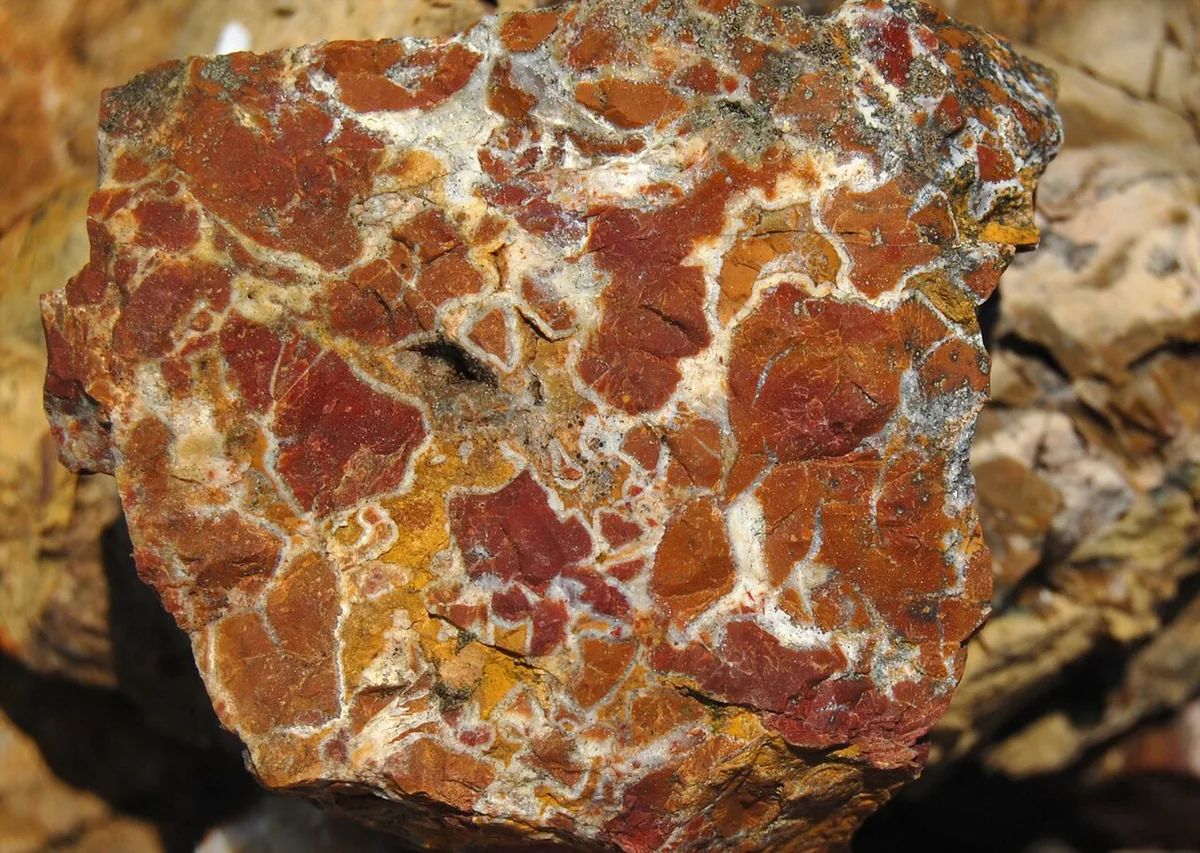
Jasper is the opaque cryptocrystalline form of quartz — like Chalcedony but with sufficient impurities (iron oxides, clays, organic) to render it opaque rather than translucent. Color and pattern are diagnostic of named varieties: red jasper (Fe oxides), picture jasper (banded landscape patterns), ocean jasper (Madagascar orbicular), and mookaite (Australian).
Jasper is the opaque cryptocrystalline form of quartz — like Chalcedony but with sufficient impurities (iron oxides, clays, organic) to render it opaque rather than translucent. Color and pattern are diagnostic of named varieties: red jasper (Fe oxides), picture jasper (banded landscape patterns), ocean jasper (Madagascar orbicular), and mookaite (Australian). Jasper has been used for ornament since the Stone Age.