Bornite sits at 3 on the Mohs scale —
can be scratched by a steel knife.
Colors:
Streak Greenish-black
Crystal system Orthorhombic (low-T) / Cubic (high-T)
Type localityMt. Cornwall, England (and Bohemian mining districts)
Sulfides & SulfosaltsSulfides
TL;DR · 1 min read
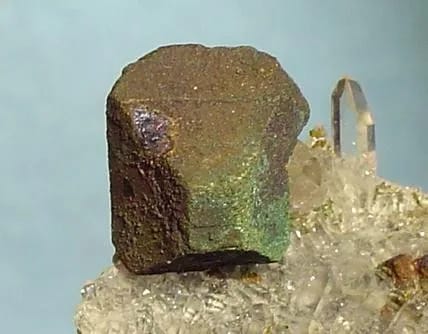
Bornite (Cu₅FeS₄) is one of the most vivid copper sulfides and a major copper ore. Fresh surfaces show a bronze-pink metallic color, but the mineral rapidly tarnishes to vivid iridescent purple, blue, and gold — the famous "peacock ore" effect treasured by collectors.
Bornite (Cu₅FeS₄) is one of the most vivid copper sulfides and a major copper ore. Fresh surfaces show a bronze-pink metallic color, but the mineral rapidly tarnishes to vivid iridescent purple, blue, and gold — the famous “peacock ore” effect treasured by collectors. It is closely associated with chalcopyrite in porphyry copper deposits and frequently forms exsolution intergrowths with it.
Notable Chinese Localities
Dexing Copper Mine (Jiangxi) and Daye District (Hubei) produce bornite as porphyry-copper byproducts. Tongling (Anhui) hosts smaller but high-iridescence specimens.
Cite this entry
APA
MyMineralBox Editorial Team. (2026). Bornite. My Mineral Box. Retrieved May 23, 2026, from https://mymineralbox.com/mineral-encyclopedia/minerals/bornite/
MLA
MyMineralBox Editorial Team. "Bornite." My Mineral Box, 2026, https://mymineralbox.com/mineral-encyclopedia/minerals/bornite/. Accessed May 23, 2026.
Chicago
MyMineralBox Editorial Team. "Bornite." My Mineral Box. Last modified May 4, 2026. https://mymineralbox.com/mineral-encyclopedia/minerals/bornite/.
BibTeX
@misc{mmb_bornite,
 author = {{MyMineralBox Editorial Team}},
 title = {{Bornite}},
 year = {2026},
 publisher = {My Mineral Box},
 url = {https://mymineralbox.com/mineral-encyclopedia/minerals/bornite/},
 urldate = {2026-05-23}
}
About Bornite
Bornite is a sulfide mineral in the bornite group and has the chemical formula Cu5FeS4. It crystallizes in the orthorhombic system and is relatively soft, requiring careful handling. Its combination of structural character and global distribution make it a recognized species in both systematic and aesthetic collections.
Identification & care
Specimens usually show cubic, dodecahedral, octahedral crystals (rare); usually massive or granular. Its color is typically copper-red to pinchbeck-brown. The luster is metallic, the streak is grey-black, and specimens are typically opaque. The cleavage is poor/indistinct on {111}. The fracture is irregular/uneven, which aids identification.
Collector context
How it forms
The geological setting for Bornite is typically hydrothermal copper deposits, porphyry copper systems, contact metasomatic zones; frequently found as exsolution product with chalcopyrite. It is commonly found in association with chalcopyrite, chalcocite, pyrite, galena, covellite, native copper.
Classic Chinese localities
Jiama Cu-polymetallic deposit, Dexing Cu-Mo-Au ore field and Huanggang Fe-Sn deposit are an important Chinese source for the species.
Why collectors care
Bornite is among the most visually dramatic sulfides and native metals a collector can own. Bright metallic faces, sharp crystal geometry, and good matrix contrast make a single well-selected piece carry an entire cabinet; luster integrity and termination sharpness ultimately define its collector value.
What affects value
Value in Bornite is assessed, in typical order of weight, against: (1) locality provenance; (2) crystal size; (3) termination quality and crystal completeness; (4) metallic luster integrity (absence of tarnish); (5) crystal habit elegance (parallel, radiating, or bladed); (6) matrix contrast and aesthetic balance; (7) condition and absence of re-attached crystals. Verified locality documentation and absence of cleaning residue act as strong multipliers across the above.
Frequently asked questions
What is Bornite?
Bornite has the chemical formula Cu5FeS4, crystallises in the Orthorhombic system. Bornite is a sulfide mineral known for its striking metallic crystals, with several world-class Chinese localities.
What is the chemical formula of Bornite?
The chemical formula of Bornite is Cu5FeS4.
What crystal system does Bornite belong to?
Bornite crystallises in the Orthorhombic crystal system.
Our inventory is one-of-a-kind and turns over quickly. Tell us what you're after — species, size, budget — and we'll notify you when a matching Bornite arrives from our sourcing network.
We use a small set of cookies (analytics, checkout, chat) to keep the site working and understand how visitors use it. Checkout-essential cookies are always loaded. Privacy policy