
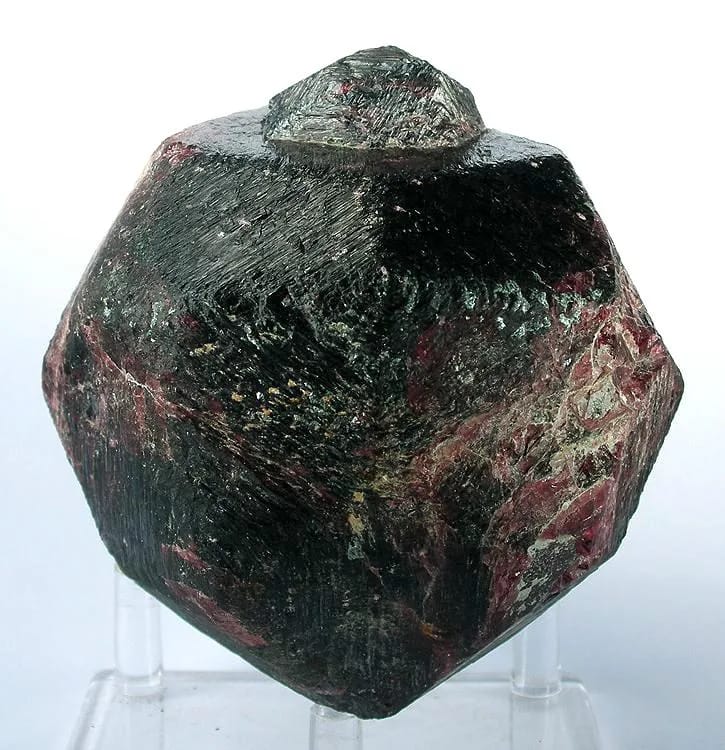
Crystal Structure
Cubic garnet — Mg₃Al₂(SiO₄)₃.
Elemental Composition (by mass)
| Element | Mass % | Visual |
|---|---|---|
| O Oxygen | 47.63% | |
| Si Silicon | 20.90% | |
| Mg Magnesium | 18.09% | |
| Al Aluminum | 13.39% |
Computed from simplified end-member formula. Solid-solution series, water content, and trace substitutions cause real-world variation.
IMA Abbreviation (Whitney-Evans 2010)
Prp
→ Pyrope
Garnet
Standard symbol from American Mineralogist (Whitney & Evans, 2010). Used in thin-section labeling, phase diagrams, and IMA-style species records.
Pronunciation
/ˈpaɪroʊp/
↔ PYE-rope
Greek "fire-eyed"
Luster
vitreous
Standard vitreous.
Color Cause (Chromophore)
Chromophore:
Fe²⁺ + Cr³⁺
Mechanism:
idiochromatic
Color produced:
red
Fe²⁺ baseline plus Cr³⁺ deepens red. Bohemian pyrope famous.
Diaphaneity (Transparency)
transparent
Mg-Al garnet — gem-grade.
Type Locality
(general) — Bohemia
Described 1803 by Werner
› Browse all type localities
Magnetism
Category:
weakly paramagnetic
Test result:
Weak but detectable
Mg-Fe garnet — usually less magnetic than almandine.
Test with rare-earth magnet (N42 or N52 neodymium). Suspend specimen on thread for sensitive paramagnetic detection. Diamagnetic minerals are weakly repelled (visible only with strong magnets like bismuth).
Specific Gravity
3.65–3.84
g/cm³
medium
Mg-Al garnet; lightest pyralspite garnet.
For comparison: water = 1.00, glass ≈ 2.5, quartz = 2.65, corundum ≈ 4.00, galena ≈ 7.50, gold ≈ 19.3.
Formation eraMantle-derived; >100 km depth. Specimens > 1Ga common from cratonic kimberlites.
Market availability: Uncommon
Found at major shows and select dealers. Quality varies by locality.
Collector tier: Solid Display
Reliable mid-tier display species. Easy to find in well-formed examples; broad locality diversity.
Mohs 7–7.5
Vickers (~) 1400 HV
Knoop (~) 1100 HK
Geological setting
KimberlitePlacer
Element composition by mass
Formula: Mg₃Al₂(SiO₄)₃ · molar mass: 403.12 g/mol
| O | 47.63% | |
| Si | 20.9% | |
| Mg | 18.09% | |
| Al | 13.39% |
Computed from atomic weights (IUPAC 2021). Site-occupancy groups (Fe,Mn) split equally.
GroupGarnet Group
Mohs Hardness
7–7.5
Pyrope sits at 7–7.5 on the Mohs scale — harder than glass; scratches steel.
Colors:
Streak
White
White
Crystal system
Isometric (Cubic)
Isometric (Cubic)
Type localityBohemia, Czech Republic
Discovery First described 1803 by Werner (Bohemia)
SilicatesSilicates (Nesosilicates)
TL;DR · 1 min read
Pyrope (Mg₃Al₂(SiO₄)₃) is the magnesium end-member of the garnet group and completes the pyralspite trio with almandine (Fe) and spessartine (Mn). Its name from Greek "pyropos" (fiery-eyed) reflects the deep wine-red to blood-red color from chromium and iron substitution.
Pyrope (Mg₃Al₂(SiO₄)₃) is the magnesium end-member of the garnet group and completes the pyralspite trio with almandine (Fe) and spessartine (Mn). Its name from Greek “pyropos” (fiery-eyed) reflects the deep wine-red to blood-red color from chromium and iron substitution. Pyrope is famous as the host garnet of diamond-bearing kimberlite pipes, and as Bohemian Garnet — the historic gem of European royal jewelry from 17th-century mines in the modern Czech Republic.
More minerals to explore
Spessartine (锰铝榴石)
Isometric (Cubic)
Almandine (铁铝榴石)
Isometric (Cubic)
Uvarovite (钙铬榴石)
Isometric (Cubic)
Staurolite (十字石)
Monoclinic
Kyanite (蓝晶石)
Triclinic
Euclase (蓝柱石)
Monoclinic
Other Members of the Garnet Group
石榴石族
- Almandine (铁铝榴石)
- Andradite (钙铁榴石)
- Grossular (钙铝榴石)
- Spessartine (锰铝榴石)
- Uvarovite (钙铬榴石)