
Crystal Structure
Phyllosilicate; chrysotile is a fibrous polymorph.
Elemental Composition (by mass)
| Element | Mass % | Visual |
|---|---|---|
| O Oxygen | 37.54% | |
| Mg Magnesium | 34.21% | |
| Si Silicon | 26.36% | |
| H Hydrogen | 1.89% |
Computed from simplified end-member formula. Solid-solution series, water content, and trace substitutions cause real-world variation.
IMA Abbreviation (Whitney-Evans 2010)
Srp
→ Serpentine
Group symbol
Standard symbol from American Mineralogist (Whitney & Evans, 2010). Used in thin-section labeling, phase diagrams, and IMA-style species records.
Pronunciation
/ˈsɜːrpəntiːn/
↔ SUR-pun-teen
Latin "serpent"
Pseudomorph Relationships
Replaces — this mineral is often a pseudomorph after:
← Olivine replacement (serpentinization)
Olivine hydrolyzes to serpentine — major rock-forming reaction in altered peridotite.
Worldwide ophiolite belts.
A pseudomorph (Greek "false form") is a mineral with the external shape of another species — the chemistry has changed but the crystal habit is inherited.
Tenacity
Behavior:
tough (fibrous)
Under stress:
Fibers resist breaking
Chrysotile asbestos — flexible interlocking fibers.
Luster
waxy→greasy
Waxy to greasy; can be silky in fibrous habits.
Type Locality
(general) — Worldwide
Described 1564 by Agricola
› Browse all type localities
Specific Gravity
2.40–2.60
g/cm³
light
Soft (Mohs 3-5); waxy luster.
For comparison: water = 1.00, glass ≈ 2.5, quartz = 2.65, corundum ≈ 4.00, galena ≈ 7.50, gold ≈ 19.3.
Mohs 2–4
Vickers (~) 170 HV
Knoop (~) 185 HK
Geological setting
Hydrothermal
Element composition by mass
Formula: Mg₃Si₂O₅(OH)₄ · molar mass: 277.11 g/mol
| O | 51.96% | |
| Mg | 26.31% | |
| Si | 20.27% | |
| H | 1.46% |
Computed from atomic weights (IUPAC 2021). Site-occupancy groups (Fe,Mn) split equally.
Mohs Hardness
2–4
Serpentine sits at 2–4 on the Mohs scale — can be scratched by a steel knife.
Colors:
Streak
White
White
Crystal system
Monoclinic
Monoclinic
SilicatesSilicates (Phyllosilicates)
TL;DR · 1 min read
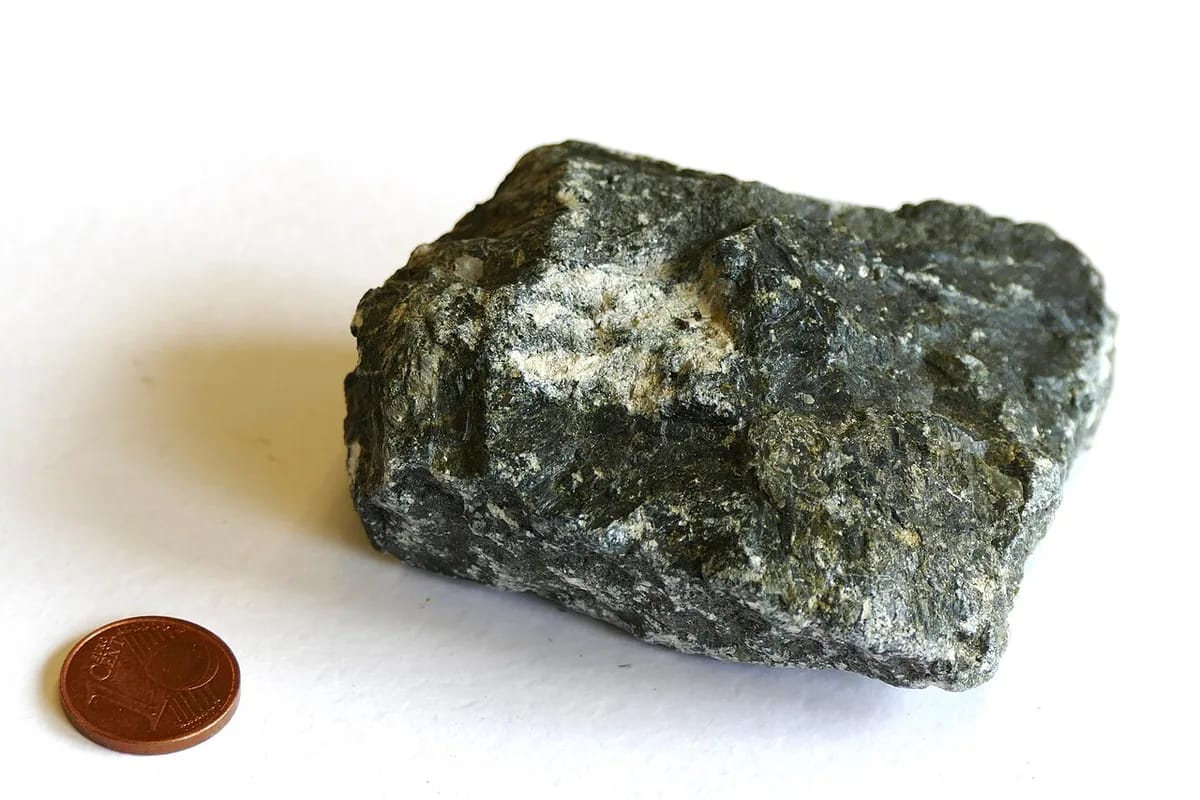
Serpentine is a group of related sheet-silicate minerals (chrysotile, antigorite, lizardite) forming hydrothermal alteration products of olivine in ultramafic rocks. Massive serpentine ("bowenite") is widely carved as ornamental "new jade.
Serpentine is a group of related sheet-silicate minerals (chrysotile, antigorite, lizardite) forming hydrothermal alteration products of olivine in ultramafic rocks. Massive serpentine (“bowenite”) is widely carved as ornamental “new jade.” Xiuyan (Liaoning) supplies major Chinese ornamental serpentine. Chrysotile is the principal asbestos mineral.