
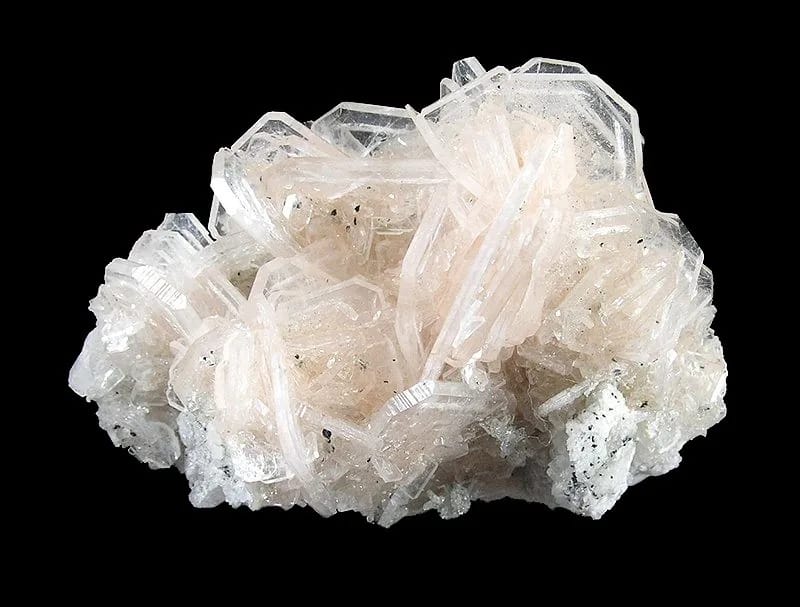
Apophyllite sits at 4.5–5 on the Mohs scale —
can be scratched by a steel knife.
Colors:
Streak White
Crystal system Tetragonal
SilicatesSilicates (Phyllosilicates)
TL;DR · 1 min read
Apophyllite (KCa₄Si₈O₂₀(F,OH)·8H₂O) is a tetragonal phyllosilicate famous for its glassy, water-clear pyramidal crystals on chalcedony or stilbite matrix in basalt cavities. The Indian Deccan Traps — particularly the Pune and Jalgaon districts in Maharashtra — produce the world's most prized Apophyllite specimens, with sharp single crystals reaching 10+ cm and complete pyramid terminations.
Apophyllite (KCa₄Si₈O₂₀(F,OH)·8H₂O) is a tetragonal phyllosilicate famous for its glassy, water-clear pyramidal crystals on chalcedony or stilbite matrix in basalt cavities. The Indian Deccan Traps — particularly the Pune and Jalgaon districts in Maharashtra — produce the world’s most prized Apophyllite specimens, with sharp single crystals reaching 10+ cm and complete pyramid terminations. The pearly luster on basal pinacoid surfaces is diagnostic.
Apophyllite belongs to the silicate class in the apophyllite group and has the chemical formula KCa4(Si8O20)F·8H2O. It crystallizes in the tetragonal system and is one of the most visually varied minerals in the collector market. Its combination of structural character and global distribution make it a recognized species in both systematic and aesthetic collections.
Identification & care
Apophyllite typically forms prismatic to tabular tetragonal crystals; often steep pyramidal terminations; cubic-looking; drusy. Its color range is broad, including colorless, white, pale green (most popular collector form), pink, yellow, and violet. The luster is vitreous, pearly (on {001}), the streak is white, and specimens range from transparent to translucent. The cleavage is perfect on {001} — basal cleavage gives pearly luster. The fracture is uneven, which aids identification.
Collector context
How it forms
In terms of geology, Apophyllite forms in vesicles and voids in basalt and volcanic rocks; hydrothermal veins; contact metamorphic zones; often with zeolites and calcite. It is commonly found in association with stilbite, heulandite, calcite, prehnite, gyrolite, okenite, natrolite.
Why collectors care
Collectors pursue Apophyllite for the clarity of its crystal form and, in good material, saturated color that reads instantly across a display case. A well-terminated apophyllite on clean matrix photographs well, identifies quickly, and anchors a cabinet piece. Top Chinese specimens over the last two decades have reset the bar for what apophyllite looks like at collector grade.
What affects value
Value in Apophyllite is assessed, in typical order of weight, against: (1) locality provenance; (2) size relative to the species norm; (3) crystal form and termination sharpness; (4) color saturation and zoning; (5) transparency and internal clarity; (6) matrix quality and aesthetic balance; (7) condition (absence of damage, chips, or repair). Cleaning quality and verified locality documentation act as multipliers across the above.
Naming history
The name Apophyllite has a specific etymological and historical context — see Mindat's reference entry for provenance details. We have retained naming data at the record level; published prose is paraphrased from factual fields rather than copied from source.
Frequently asked questions
What is Apophyllite?
Apophyllite is a silicate mineral prized by collectors for its exceptional color range.
What crystal system does Apophyllite belong to?
Apophyllite crystallises in the Tetragonal crystal system.
Mindat.org is the world’s largest open mineralogy database. Our descriptions are written independently and fact-checked.
Cookies on MyMineralBox
We use a small set of cookies (analytics, checkout, chat) to keep the site working and understand how visitors use it. Checkout-essential cookies are always loaded. Privacy policy