
Crystal Structure
Orthorhombic Al₂SiO₅ — high-temperature polymorph.
Elemental Composition (by mass)
| Element | Mass % | Visual |
|---|---|---|
| O Oxygen | 49.37% | |
| Al Aluminum | 33.30% | |
| Si Silicon | 17.33% |
Computed from simplified end-member formula. Solid-solution series, water content, and trace substitutions cause real-world variation.
IMA Abbreviation (Whitney-Evans 2010)
Sil
→ Sillimanite
Al₂SiO₅ polymorph
Standard symbol from American Mineralogist (Whitney & Evans, 2010). Used in thin-section labeling, phase diagrams, and IMA-style species records.
Pronunciation
/ˈsɪləmənaɪt/
↔ SIL-uh-muh-nite
named for B. Silliman
Diaphaneity (Transparency)
transparent-to-translucent
Fibrolite variety is translucent.
Pleochroism (trichroic)
Axis a
colorless / yellow-green
Axis b
green
Axis c
blue
Strength: strong
Rare gem-quality material from Sri Lanka and Burma.
Cleavage & Fracture
Cleavage:
perfect 1 direction {010}
Fracture:
splintery
Fibrous habit (fibrolite variety).
Collector tier: Micromount / Niche
Best appreciated at thumbnail or smaller scale — often dull-colored, sub-millimeter, or radioactive. Specialist appeal.
PolymorphsShares the formula
Al2SiO5 with: Kyanite · Andalusite — same chemistry, different crystal structure.Mohs 6.5–7.5
Vickers (~) 1400 HV
Knoop (~) 1100 HK
Geological setting
Metamorphic
Element composition by mass
Formula: Al₂SiO₅ · molar mass: 162.04 g/mol
| O | 49.37% | |
| Al | 33.3% | |
| Si | 17.33% |
Computed from atomic weights (IUPAC 2021). Site-occupancy groups (Fe,Mn) split equally.
Mohs Hardness
6.5–7.5
Sillimanite sits at 6.5–7.5 on the Mohs scale — harder than glass; scratches steel.
Colors:
Streak
White
White
Crystal system
Orthorhombic
Orthorhombic
Pronunciation/ˈsɪlɪməˌnaɪt/
SilicatesSilicates (Nesosilicates)
TL;DR · 1 min read
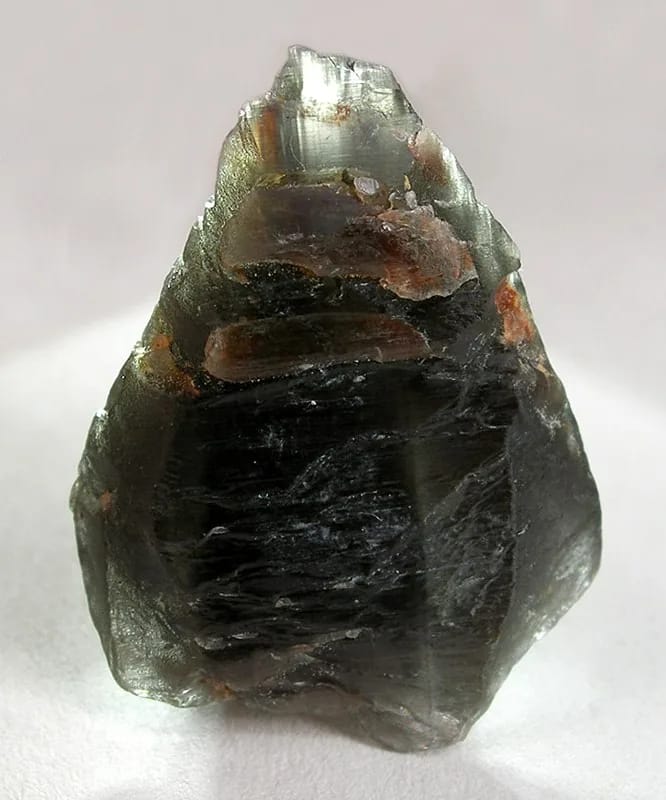
Sillimanite (Al₂SiO₅) is the high-temperature aluminosilicate polymorph (with kyanite high-P, andalusite low-P/T). It forms long fibrous prismatic crystals in high-grade metamorphic rocks.
Sillimanite (Al₂SiO₅) is the high-temperature aluminosilicate polymorph (with kyanite high-P, andalusite low-P/T). It forms long fibrous prismatic crystals in high-grade metamorphic rocks. The fibrous variety “fibrolite” is occasionally cut as gemstone for cat’s-eye effect. Sri Lanka and Madagascar supply gem material.